Published by Intellawaste | Waste Cost Reduction
A Strategic Approach to Waste Management Efficiency and Cost Control
Managing waste across multiple business locations presents a unique set of challenges. From inconsistent pricing and fragmented vendor contracts to lack of visibility and billing errors, organizations often struggle to control costs effectively. What may seem like small inefficiencies at a single location can quickly multiply into significant expenses when scaled across dozens—or even hundreds—of sites.
For organizations looking to reduce waste costs multiple locations, the key is not just cutting expenses, but creating a structured, data-driven strategy that improves visibility, accountability, and operational efficiency.
Understanding where waste costs originate—and how to control them—can lead to substantial long-term savings.
Why Waste Costs Increase Across Multiple Locations
As businesses expand, waste management often becomes decentralized. Different locations may work with different vendors, operate under separate contracts, and follow inconsistent service schedules.
This lack of standardization leads to:
- Overlapping or unnecessary services
- Inconsistent pricing across locations
- Limited oversight into vendor performance
- Billing discrepancies and hidden fees
Without centralized oversight, organizations lose the ability to identify inefficiencies and optimize spending.
The Importance of Centralized Waste Data
One of the most effective ways to control costs is by creating visibility across all locations. Without access to accurate, consolidated data, it becomes nearly impossible to identify trends or areas for improvement.
Using waste data management across multiple locations, businesses can:
- Track total waste spend in real time
- Compare costs between locations
- Identify anomalies and billing errors
- Monitor service levels and frequency
Centralized data transforms waste management from a reactive process into a proactive strategy.
Standardizing Vendor Contracts and Pricing
Many organizations unknowingly pay different rates for identical services at different locations. This often happens when contracts are negotiated independently without a unified strategy.
Through multi-location waste contract optimization, businesses can:
- Consolidate vendors where appropriate
- Negotiate consistent pricing structures
- Eliminate redundant or unnecessary services
- Ensure contracts align with actual operational needs
Standardization not only reduces costs but also simplifies management across locations.
Eliminating Billing Errors and Overcharges
Billing errors are one of the most common—and costly—issues in waste management. Overcharges, incorrect service levels, and hidden fees can go unnoticed without proper auditing.
Implementing waste invoice auditing for cost savings allows businesses to:
- Identify discrepancies in billing
- Recover overpayments
- Ensure charges match contracted rates
- Improve vendor accountability
Even small corrections can result in significant savings when applied across multiple locations.
Optimizing Service Levels for Each Location
Not all locations generate the same amount of waste. However, many businesses operate under standardized service schedules that do not reflect actual usage.
With waste service level optimization for businesses, organizations can:
- Adjust pickup frequency based on need
- Right-size container usage
- Reduce unnecessary service calls
- Align services with operational demands
This tailored approach prevents over-servicing and reduces unnecessary costs.
Improving Vendor Accountability and Performance
Managing multiple vendors across different regions can create inconsistencies in service quality and responsiveness. Without performance tracking, it is difficult to hold vendors accountable.
Using waste vendor performance tracking systems, businesses can:
- Monitor service reliability
- Track missed pickups or service issues
- Evaluate vendor responsiveness
- Ensure compliance with contract terms
This level of oversight ensures that vendors deliver value and maintain service standards.
Leveraging Technology for Waste Cost Reduction
Technology plays a critical role in modern waste management. Without the right tools, managing multiple locations becomes inefficient and prone to errors.
Platforms that provide waste management software for multi-location businesses enable organizations to:
- Centralize all waste-related data
- Automate invoice tracking and validation
- Generate reports for decision-making
- Identify cost-saving opportunities
With the right system in place, businesses gain full control over their waste operations.
Identifying Hidden Cost Drivers

Waste costs are not always straightforward. Hidden fees, inefficient service schedules, and underutilized resources can quietly increase expenses over time.
By analyzing waste cost drivers across multiple locations, businesses can uncover:
- Unused or unnecessary services
- Overfilled or underutilized containers
- Inefficient routing or scheduling
- Opportunities for consolidation
Addressing these hidden factors leads to more sustainable cost reductions.
Creating a Scalable Waste Management Strategy
As businesses grow, their waste management strategy must scale with them. A fragmented approach that works for a few locations may not be effective across a larger footprint.
Developing scalable waste management solutions for enterprises ensures that:
- Processes remain consistent across all locations
- Data is centralized and accessible
- Costs are controlled as operations expand
- Decision-making is driven by accurate insights
A scalable strategy prevents inefficiencies from growing alongside the business.
Supporting Sustainability While Reducing Costs
Cost reduction and sustainability often go hand in hand. By optimizing waste management processes, businesses can reduce landfill contributions while improving operational efficiency.
Through sustainable waste reduction strategies for businesses, organizations can:
- Increase recycling rates
- Reduce overall waste volume
- Improve environmental impact
- Align with corporate sustainability goals
These efforts not only reduce costs but also strengthen brand reputation.
A Smarter Approach to Waste Cost Control
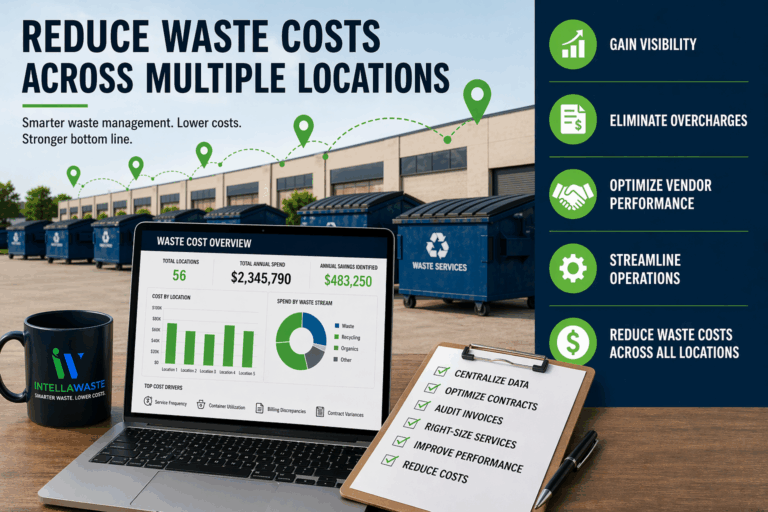
Reducing waste costs across multiple locations requires more than isolated changes—it demands a comprehensive, data-driven approach. By centralizing data, optimizing contracts, auditing invoices, and leveraging technology, businesses can gain control over their waste operations.
For organizations seeking to reduce waste costs multiple locations, the focus should be on visibility, accountability, and continuous improvement.
At IntellaWaste, we help businesses transform waste management into a strategic advantage—delivering cost savings, operational efficiency, and scalable solutions across every location.
Ready to see your operation clearly? Book a demo with Intellawaste today and discover what your business looks like when the data works for you instead of against you.
Intellawaste provides waste management software solutions for haulers across the United States.