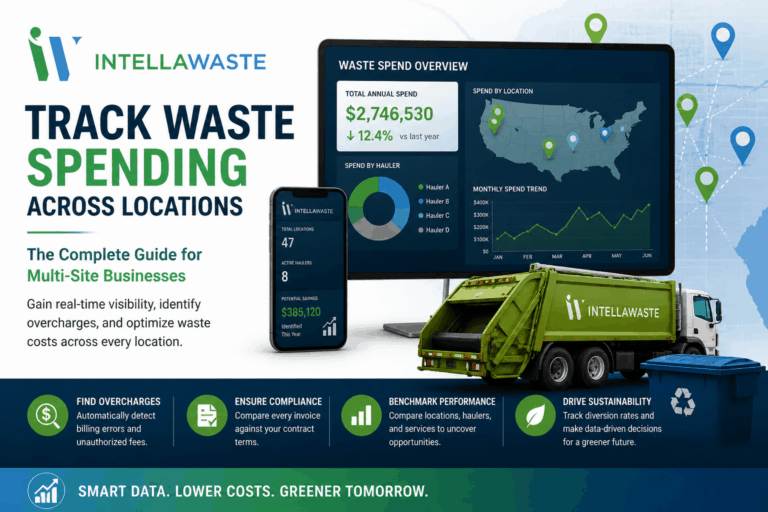
Stop guessing where your waste dollars are going. Here’s how smart businesses use waste management software to take full control of costs across every site.
If your business operates across multiple locations — whether that is a regional restaurant chain, a portfolio of commercial properties, a network of retail stores, or a healthcare system with dozens of facilities — you already know that waste is one of the most frustrating line items on your P&L. The bills come in from different haulers, at different frequencies, in different formats, and often with little explanation for why costs have changed from one month to the next.
The result is that most multi-location businesses have almost no real visibility into what they are spending on waste. They pay the invoices, absorb the rate increases, and move on — because tracking it all manually is simply not worth the time it would take.
That is exactly the problem Intellawaste was built to solve. As a purpose-built waste management software platform, Intellawaste gives businesses of every size and industry the ability to track waste spending across locations in real time, identify overcharges, benchmark performance, and make data-driven decisions that cut costs without cutting corners.
In this guide, we break down exactly why tracking waste spend is so difficult for multi-site operations, what good visibility actually looks like, and how the right software transforms waste from a black box into a fully managed, optimized expense.
Why Tracking Waste Spending Across Locations Is So Hard
To understand why waste spend is so difficult to track, it helps to understand how the industry works. Most businesses — especially those with multiple locations — deal with a fragmented hauler landscape. A restaurant chain with 30 locations might have 8 different haulers across its portfolio, each with its own billing system, contract terms, service schedule, and rate structure.
That fragmentation creates several compounding problems:
- Invoices arrive in different formats — paper, PDF, email, portal — making centralized tracking nearly impossible without manual data entry
- Rate increases are buried in invoice line items and rarely flagged proactively by haulers
- Fuel surcharges, environmental fees, and overage charges are often applied inconsistently or without contractual basis
- Service levels at individual locations frequently drift from what was contracted — missed pickups, extra pulls, or unapproved container swaps — and those changes show up as surprise charges
- Without a centralized system, finance teams have no way to benchmark one location against another or identify which sites are performing well and which are outliers
The consequence is that most businesses are significantly overpaying for waste services without knowing it. Industry estimates suggest that 20 to 30 percent of waste invoices contain billing errors or unauthorized charges — and in the absence of a systematic way to track waste spending, those errors simply get paid.
The Hard Truth: If you are managing waste invoices in spreadsheets or relying on your haulers to bill you correctly, you are almost certainly overpaying. The question is not whether you have waste billing errors — it is how much they are costing you.
What It Means to Actually Track Waste Spending
Tracking waste spending is not the same as paying waste invoices. True spend tracking means having a clear, current, and complete picture of what every location in your portfolio is spending on waste services — broken down by hauler, service type, container size, pickup frequency, and cost per unit of waste diverted.
For a multi-location business, that means being able to answer questions like:
- Which of my locations has the highest waste cost per square foot — and why?
- Am I being billed at the rates specified in my contracts, or have haulers been applying unauthorized increases?
- Which haulers are consistently overcharging or under-delivering?
- How does my recycling diversion rate compare across locations, and where am I leaving sustainability credits on the table?
- What would my total waste spend look like if I renegotiated contracts in underperforming markets?
- Are there locations where I am over-serviced — paying for more pickups than I actually need?
These are not exotic questions. They are the basic intelligence any operations or finance leader should have about a major recurring expense. But without the right tools, they are nearly impossible to answer — because the data lives in dozens of disconnected invoices, across dozens of hauler accounts, spread across every location in the portfolio.
Effective waste spend tracking consolidates all of that data into a single platform where patterns become visible, anomalies get flagged automatically, and decision-makers can act on real information rather than estimates and gut feel.
The Role of Waste Management Software in Spend Visibility
Waste management software is the infrastructure layer that makes systematic spend tracking possible. Rather than relying on manual invoice processing, spreadsheet reconciliation, and ad hoc communication with haulers, a platform like Intellawaste automates the collection, validation, and analysis of waste spend data across your entire portfolio.
Here is what that looks like in practice:
1. Centralized Invoice Processing: Intellawaste ingests invoices from all of your haulers — regardless of format — and normalizes the data into a consistent structure. Every charge, at every location, from every hauler, flows into a single system where it can be reviewed, approved, and analyzed.
2. Contract Compliance Auditing: Every invoice is automatically checked against the contracted rates and service terms for that location. When a hauler bills at a rate that does not match the contract, or applies a fee that was not agreed upon, the system flags it immediately — before payment is made.
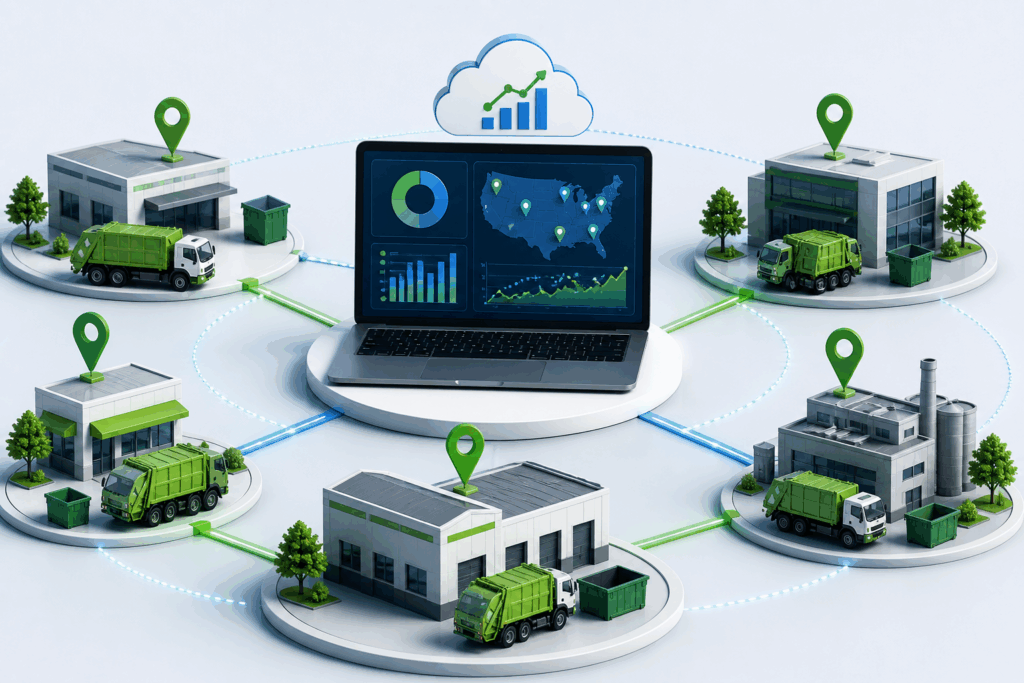
3. Spend Dashboards by Location: Finance and operations teams get real-time dashboards showing waste spend broken down by location, region, hauler, service type, and time period. Outliers are immediately visible. Trends are easy to spot. Comparisons across the portfolio are a single click away.
4. Service Level Monitoring: Intellawaste tracks service events — pickups, missed pulls, container swaps — and cross-references them against what was scheduled and contracted. If a location is not getting the service it is paying for, the platform captures that discrepancy and supports the dispute process.
5. Reporting and Benchmarking: Custom reports allow businesses to benchmark waste spend per location, per square foot, per unit of revenue, or against industry standards. That benchmarking data is the foundation for renegotiating contracts, optimizing service levels, and building a business case for operational changes.
The cumulative effect of these capabilities is that businesses using waste management software shift from reactive invoice processing to proactive spend management — and that shift consistently produces measurable cost savings.
Industries That Benefit Most from Tracking Waste Spend
While virtually any multi-location business can benefit from better waste spend visibility, certain industries face particularly acute challenges — and see particularly strong results from implementing a structured tracking approach.
Restaurants and Food Service
Food service operations generate high volumes of organic waste, grease, and recyclables — often managed through multiple service streams with different haulers. Without centralized tracking, over-service and billing errors are rampant. Intellawaste helps restaurant groups consolidate hauler relationships, align service frequency with actual waste generation, and eliminate the chronic overpayment that plagues the industry.
Retail and Franchise Operations
Retail chains and franchise networks often have locations spread across dozens of markets, each with locally negotiated hauler contracts and no visibility from the corporate level. Intellawaste creates the centralized oversight that corporate operations and finance teams need to standardize contracts, enforce compliance, and identify locations that are dramatically out of line with portfolio averages.
Property Management and Real Estate
Property managers overseeing commercial portfolios deal with waste as both a direct operating expense and a tenant relations issue. Accurate spend tracking allows property managers to allocate waste costs correctly across tenants, identify properties where waste services are misaligned with occupancy levels, and build a defensible case for renegotiating hauler contracts across the portfolio.
Healthcare and Medical Facilities
Healthcare organizations manage multiple waste streams — regulated medical waste, pharmaceutical waste, general solid waste, and recycling — each with its own compliance requirements and cost structure. Intellawaste provides the visibility needed to track spend across all streams, ensure regulatory compliance documentation is current, and identify consolidation opportunities that reduce both cost and administrative burden.
Common Waste Billing Errors That Cost Businesses Thousands
One of the most immediate benefits of implementing waste spend tracking is the discovery of billing errors that have been silently draining budget for months or years. The most common errors that Intellawaste clients uncover include:
- Rate creep: Haulers incrementally increase rates between contract renewal cycles, often in small increments that fly under the radar of manual invoice review
- Duplicate billing: The same service event billed twice — particularly common when invoicing is handled by automated systems that do not reconcile against service records
- Unauthorized fee additions: Environmental fees, fuel surcharges, and administrative fees added without contractual authorization or applied at rates above what was agreed
- Overage charges for containers that were not actually overflowing: Haulers sometimes apply overage fees based on internal estimates rather than actual observations
- Billing for missed services: Charges for pickups that did not occur — one of the most common and most infuriating billing errors for operations teams
- Incorrect container size billing: Locations billed for a container size larger than what is actually on site
In aggregate, these errors are not trivial. For a business spending $500,000 annually on waste services across its portfolio, even a 15 percent error rate represents $75,000 in recoverable costs per year. For larger portfolios, the number is proportionally higher — and the savings from systematic tracking and dispute management compound over time.
Intellawaste Insight: On average, businesses that implement systematic waste spend tracking recover between 15 and 30 percent of their annual waste spend through billing error identification and contract renegotiation in the first year alone.
How to Get Started: A Practical Roadmap
Implementing a waste spend tracking program does not have to be disruptive or time-consuming — especially when the right software handles the heavy lifting. Here is a practical roadmap for multi-location businesses getting started with Intellawaste:
Step 1. Conduct a Waste Spend Audit: Before you can optimize, you need a baseline. Intellawaste begins by gathering your existing invoices, contracts, and hauler account information across all locations and building a complete picture of your current spend. This audit typically reveals the first round of billing errors and contract compliance issues.
Step 2. Centralize Your Hauler Contracts: All contracts are loaded into the platform, making contracted rates, service terms, and renewal dates visible in one place. This is the foundation for ongoing invoice validation and the starting point for renegotiation conversations.
Step 3. Automate Invoice Processing: Once the platform is configured, invoice processing becomes automated. Invoices are ingested, validated against contracts, and flagged for exceptions — without requiring manual review of every line item.
Step 4. Establish Reporting Cadence: Work with your Intellawaste team to set up the dashboards and reports that matter most to your organization — whether that is monthly spend by region, hauler performance scorecards, or sustainability metrics for ESG reporting.
Step 5. Use Data to Renegotiate and Optimize: With 90 days of clean data, most businesses have enough intelligence to approach hauler renegotiations from a position of strength — with specific data on pricing, service levels, and market benchmarks to support their position.
The entire onboarding process is managed by Intellawaste’s implementation team, so your internal staff does not need to become waste industry experts. The platform does the analytical work; your team makes the decisions.
Beyond Cost Savings: Sustainability and ESG Reporting
For a growing number of businesses, tracking waste spending is about more than the bottom line. Environmental, social, and governance (ESG) reporting requirements — whether driven by investors, regulators, customers, or internal commitments — increasingly require businesses to document waste diversion rates, landfill avoidance, and recycling performance.
Intellawaste supports these requirements by tracking not just waste spend but waste volumes, service types, and diversion metrics across every location. That data feeds directly into ESG reports, sustainability dashboards, and regulatory filings — eliminating the manual data collection process that makes sustainability reporting so labor-intensive for multi-location businesses.
Businesses that can demonstrate consistent, data-backed progress on waste reduction and diversion are increasingly competitive — both in attracting ESG-focused capital and in meeting the expectations of environmentally conscious customers and partners.
The Bottom Line: Waste Spend Visibility Is a Competitive Advantage
For too long, waste has been treated as an unmanageable overhead expense — a cost of doing business that businesses simply absorb without scrutiny. The reality is that waste spend, like any other significant operating expense, responds to management attention, data-driven decision making, and smart vendor relationships.
Businesses that invest in the infrastructure to track waste spending across locations consistently outperform their peers on this expense line — not because they cut corners on service, but because they stop paying for things they are not getting and stop accepting rates that do not reflect the market.
Intellawaste makes that infrastructure accessible to businesses of any size, in any industry, anywhere in the country. Whether you operate 5 locations or 500, the platform gives you the visibility, the tools, and the expert support to turn waste from a frustrating black box into a fully managed, optimized line item.
Ready to track waste spending across your locations? Intellawaste helps multi-location businesses across the country take control of waste costs through intelligent software, automated invoice auditing, and expert support. Schedule a free demo today and see exactly what your portfolio is spending — and where you can save.