Published by IntellaWaste | Operational Efficiency
There is a version of waste management operations that most brokers, consultants, and multi-site businesses know very well — the one built on spreadsheets, manual invoice collection, email chains with haulers, and a staff member whose entire job is chasing down invoices before the billing cycle closes. It works, in the way that a leaking bucket works if you keep refilling it. But it is slow, expensive, error-prone, and structurally incapable of scaling without adding headcount proportionally.
The operational inefficiency embedded in traditional waste management processes is not a minor inconvenience. It is a direct cost — in labor, in missed overbilling events, in delayed invoicing, in data that arrives too late to act on, and in the compounding complexity that grows every time a new client, location, or hauler is added to the portfolio. For waste brokers managing hundreds of client locations, and for corporate clients overseeing multi-site waste programs across multiple states, the gap between what manual processes can deliver and what the business actually needs keeps widening.
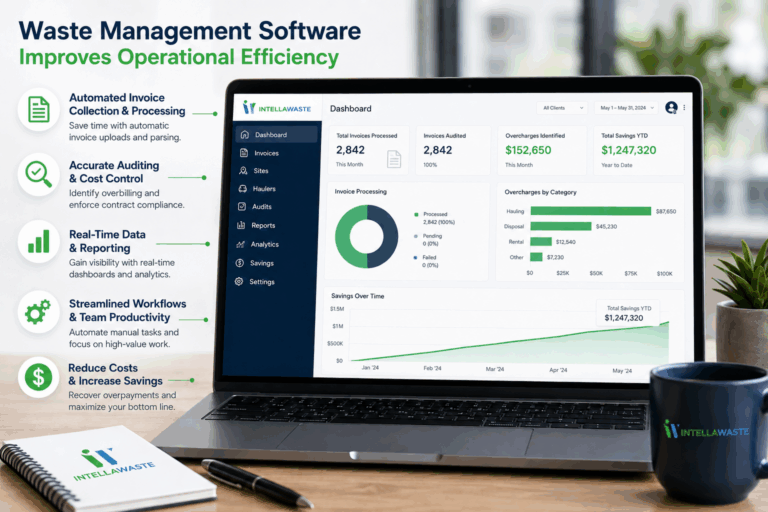
Waste management software closes that gap. Not by automating a single task or solving one piece of the puzzle, but by transforming the entire operational framework — replacing manual workflows with automated, intelligent processes that improve accuracy, reduce costs, and give businesses the data visibility they need to make genuinely informed decisions.
This is what operational efficiency looks like in waste management when software is doing the work it should be doing.
The Operational Problem Most Businesses Underestimate
Before examining what waste management software does, it is worth being precise about what it replaces — and why those legacy processes are more costly than they appear.
The core operational challenge in waste management, particularly for brokers and multi-location corporate clients, is the invoice. Every month, haulers generate invoices for every service location. Those invoices need to be collected, matched to the correct customer account, reviewed against contracted rates, audited for discrepancies, entered into accounting systems, and used as the basis for billing clients. Multiply that process by hundreds or thousands of locations, across dozens of haulers, each with their own invoice formats, billing schedules, and pricing structures, and the scale of the manual effort becomes clear.
The people doing this work are not doing it badly. They are doing the best possible job with the tools available to them. But manual processes have structural limitations that no amount of diligence can overcome. Invoices arrive in different formats — PDFs, emails, paper, portals. Some haulers send them on time. Others do not. Line items are described inconsistently across haulers, making comparison to contract terms genuinely difficult. Overbilling events — price discrepancies where a hauler charges beyond contracted terms — are embedded in the complexity by design, making them hard to catch without a systematic approach.
As IntellaWaste clients have consistently reported, the result is that companies routinely overpay for waste services without knowing it — and when they try to recover those overpayments manually, the process takes months and consumes staff time that could be deployed elsewhere. Addressing how companies overpay for waste services requires more than vigilance. It requires a system built specifically to catch what human review misses.
Efficiency Gain 1: Automated Invoice Collection and Processing
The first and most immediate operational efficiency that waste management software delivers is the elimination of manual invoice collection. This is the task that, at scale, consumes more staff time than any other in the waste management back office — and it is also the task most amenable to complete automation.
IntellaWaste’s automatic invoice uploads and parsing capability transforms this process entirely. Once a client account is configured on the platform, hauler invoices are automatically collected, uploaded, and parsed — regardless of their format. Paper invoices can be scanned into a single PDF and processed automatically. Digital invoices are captured directly. Each invoice is read line by line, assigned to the correct customer location using unique identification codes and multi-layer filtering, and made available for viewing, tracking, and auditing.
The practical impact is significant. A waste broker who previously had a staff member dedicated entirely to invoice collection — spending weeks each month chasing down documents from haulers who don’t send them reliably — can redirect that person to work that actually grows the business. The invoices arrive, get processed, and are ready for review without anyone having to hunt for them.
For businesses managing 1,000 or 10,000 locations, this is not a marginal efficiency gain. It is a structural transformation of the back-office operation. IntellaWaste clients have reported labor cost reductions of up to 95% on invoice processing alone — not because the work disappeared, but because software now does what people were doing before. Explore the full IntellaWaste product suite to see the complete range of automation capabilities the platform delivers.
Efficiency Gain 2: Real-Time Integration with Accounting Software
Even after invoices are collected and processed, the traditional workflow requires someone to manually enter data into the accounting system. For high-volume operations, this is another significant source of labor cost, delay, and data entry error — and it introduces a lag between when invoices are received and when they are reflected in financial reporting.
Real-time hauler invoice imports into accounting software eliminate this step. IntellaWaste integrates seamlessly with major accounting platforms — including QuickBooks and NetSuite — automatically pushing invoice data from the waste management platform directly into the client’s accounting system. No manual entry. No lag. No transcription errors.
For waste brokers, this has a direct impact on cash flow. The ability to invoice clients faster — because the hauler invoice data is already in the system, accurately categorized and ready to act on — compresses the billing cycle and reduces the period between service delivery and payment. For corporate clients, real-time accounting integration means that waste spend is visible in financial reporting as it happens, not weeks later when someone has finished entering data manually.
This kind of financial visibility is foundational to operational efficiency. You cannot manage costs you cannot see clearly, and you cannot see them clearly when the data arrives late through a manual process. Real-time integration solves both problems simultaneously.
Efficiency Gain 3: Systematic Invoice Auditing That Catches What Humans Miss
Of all the operational improvements that waste management software delivers, none has a more direct financial impact than automated invoice auditing. This is where the real money is found — and where manual processes fail most consistently.
Hauler overbilling is pervasive in the industry. Haulers charge beyond contracted terms in ways that range from outright errors to deliberate complexity — fuel surcharges that exceed contract allowances, rate increases applied outside the permitted schedule, environmental fees that don’t match agreed terms, extra pickup charges that appear without authorization. Each individual discrepancy may be small. Across thousands of invoices over months or years, they accumulate into very substantial overpayments.
Manual auditing can catch some of these events. But it requires someone to read every line item on every invoice, compare it to the relevant contract terms, and flag the discrepancy — for every invoice, every month, across every hauler and location. At any meaningful scale, this is simply not feasible to do thoroughly. Things get missed. Waste invoice auditing done manually is always incomplete auditing.
IntellaWaste’s hauler contract tracking and invoice auditing module automates this process. Every hauler contract is loaded into the system — with contracted rates, permitted increase schedules, allowable surcharges, and service definitions all tracked. When an invoice arrives, the system automatically compares every line item to the contract terms and flags any discrepancy immediately, the same day the invoice is received. Nothing waits. Nothing slips through because someone was busy with another account.
The financial results speak for themselves: IntellaWaste clients have recognized over $1,000,000 in overbilling events caught by the platform — money that would have been lost permanently under manual processes.
Efficiency Gain 4: Overbilling Case Management That Drives Resolution
Catching an overbilling event is only half the work. The other half is resolving it — getting the hauler to issue a credit and ensuring that the discrepancy doesn’t recur. This resolution process, done manually, is slow and inconsistent. Companies often wait months for credits that haulers deprioritize or dispute. In the meantime, if the discrepant invoice is paid, the hauler may treat that payment as acceptance of the new pricing structure — locking the client into rates they never agreed to.
Hauler overbilling case management — what IntellaWaste calls Price Discrepancy (PD) management — addresses this directly. When a discrepancy is flagged, IntellaWaste creates a case that tracks the issue from identification through resolution. The documentation needed to dispute the charge is organized and accessible. The timeline is monitored. Nothing falls through the cracks because there is no caseload sitting in someone’s inbox, competing with other priorities.
For waste brokers managing multiple clients and hundreds of locations, this structured case management capability is the difference between recovering overbilled amounts consistently and systematically, and recovering them sporadically — or not at all. The operational efficiency of having every open PD tracked, documented, and monitored in one place is substantial. The financial impact of actually recovering those credits, rather than losing them, is even more significant.
If waste data visibility is broken across your operation, this is one of the most important places to start — because you cannot resolve what you have not captured and organized.
Efficiency Gain 5: Contract Monitoring That Protects Revenue
For waste brokers and consultants managing large client portfolios, the customer contract is the foundation of the business relationship — and the source of profitability. A broker’s margin depends on the spread between what the hauler charges and what the client pays. When hauler prices increase beyond contracted terms without corresponding adjustments to client contracts, or when client contracts expire without renewal at current market rates, that margin compresses.
Customer contract monitoring for waste brokering and consulting accounts gives brokers continuous visibility into the status of every client contract in their portfolio — expiration dates, pricing terms, permitted escalations, and the relationship between hauler costs and client billing. Rather than relying on calendar reminders and spreadsheets to track when contracts need attention, IntellaWaste surfaces this information automatically and proactively.
This is a genuinely different kind of operational efficiency than labor reduction. It is the efficiency of never missing a contract renewal, never letting a pricing discrepancy erode margins unnoticed, and always having current, accurate data on the financial health of each client relationship. For waste consultants and brokers, this visibility is directly tied to revenue protection — and it is exactly the kind of oversight that becomes impossible to maintain manually as a portfolio grows.
Efficiency Gain 6: Service Level Tracking and Waste Data Visibility
Operational efficiency in waste management is not only about invoicing and billing. It is also about understanding what services are actually being delivered at each location — and whether they match what was contracted, what is needed, and what is being paid for.
Service level tracking within IntellaWaste provides a complete, real-time view of waste services across all client locations: number of containers, container sizes, service types, pickup frequency, and total waste volume. This data enables something that has historically been very difficult to accomplish at scale — a systematic review of whether current service levels are appropriate, or whether locations are over-serviced, under-serviced, or paying for configurations that no longer match their actual waste generation.
The cost optimization opportunity embedded in this data is significant. Businesses that track waste spending across locations with real visibility consistently find locations where service can be right-sized — reducing container sizes, adjusting pickup frequency, or consolidating services — without sacrificing operational effectiveness. These are not theoretical savings. They are real cost reductions identified through data that was always theoretically available but practically inaccessible without software to organize and surface it.
This visibility also supports sustainability reporting. IntellaWaste’s service level tracking includes real-time landfill diversion reporting — giving businesses the data they need to measure and report on waste diversion metrics, an increasingly important consideration for corporate sustainability programs and client-facing ESG reporting.
Efficiency Gain 7: Scalability Without Proportional Headcount Growth
Perhaps the most strategically significant operational efficiency that waste management software delivers is scalability. In a manual operation, growth requires proportional investment in labor. Each new client, each new location, each new hauler relationship adds to the workload in roughly linear proportion. The business grows, but so does the headcount required to support it — and margins compress unless rates increase to compensate.
Software changes this equation. IntellaWaste is designed with no upper limit on data volume — clients currently import over 10,000 waste invoices daily through the platform, and the system automatically scales its processing capacity as volume increases. A waste broker who doubles their client base does not need to double their back-office staff. The software handles the incremental volume, and the human team focuses on client relationships, business development, and the decisions that actually require human judgment.
This scalability is what separates software-enabled waste management operations from their manual counterparts over the long term. It is also why the economics of reducing waste costs across multiple locations improve dramatically when software is handling the operational infrastructure — because the marginal cost of adding a location to a software-enabled portfolio is a fraction of what it costs in a manual operation.
What Operational Efficiency Actually Looks Like in Practice
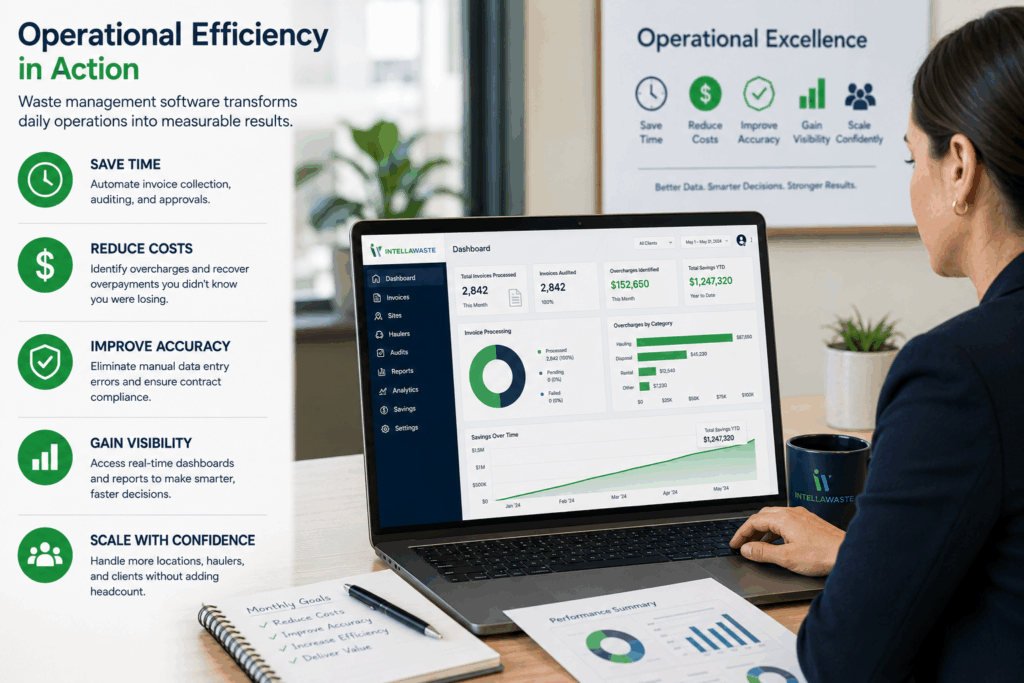
The operational improvements described in this article are not theoretical. They are the outcomes reported by IntellaWaste clients who have made the transition from manual processes to a software-enabled operation.
Global Trash Solutions reported a 95% reduction in labor costs related to invoice processing after implementing IntellaWaste — the direct result of automating a workflow that had previously consumed a significant portion of their staff’s time.
Global Environmental Group eliminated the monthly revenue leakage from hauler overbilling that had cost them roughly 10 cents on every dollar earned — because the platform now catches discrepancies the same day invoices arrive, rather than months later through manual review.
These are not edge cases. They reflect what consistently happens when a business replaces manual waste management processes with software designed specifically for the complexity and scale of this industry.
Getting Started with IntellaWaste
IntellaWaste is available at $5 per location per month with unlimited invoices — a pricing model designed to make software-enabled efficiency accessible at any scale, from a business managing 50 locations to a broker serving clients across all 50 states.
Every prospective client can try the platform before committing. A product demo gives businesses the opportunity to see the software in action, understand how it maps to their specific workflows, and make an informed decision about whether it fits their needs.
Book a demo to see how IntellaWaste works, or contact us at 844-400-6740 to speak with our team about your operation. You can also get started directly — there is no minimum location requirement, and the platform is built to deliver value from day one.
Frequently Asked Questions About Waste Management Software and Operational Efficiency
What types of businesses benefit most from waste management software? Waste brokers, waste consultants, and corporate clients managing waste programs across multiple locations benefit most significantly. Any operation processing a significant volume of hauler invoices each month — or managing contracts across multiple haulers and locations — will see immediate operational improvements from automation and auditing tools.
How quickly does IntellaWaste deliver operational improvements after implementation? Most clients begin seeing results within the first billing cycle. Invoice collection and processing automation is effective immediately after account setup. Invoice auditing begins catching discrepancies from the first invoices processed through the platform.
Does IntellaWaste integrate with my existing accounting software? Yes. IntellaWaste integrates with major accounting platforms including QuickBooks and NetSuite, enabling real-time invoice imports that eliminate manual data entry between systems.
How does IntellaWaste handle paper invoices? Paper invoices can be scanned into a PDF document and uploaded to IntellaWaste, where the platform automatically filters, sorts, parses, and assigns each invoice to the correct customer location. The system handles paper and digital invoices through the same workflow.
Is there a minimum number of locations required to use IntellaWaste? No. There is no minimum location requirement. IntellaWaste is designed to deliver value at any scale — from businesses managing a small number of locations to brokers serving thousands of client accounts nationwide.
How does IntellaWaste ensure invoice assignments are accurate across large portfolios? IntellaWaste uses unique location and customer identification codes along with multi-layer filtering to ensure that each invoice is assigned to the correct location with complete accuracy — regardless of how many locations or haulers are in the portfolio.
The material contained on this site is for informational purposes only and DOES NOT CONSTITUTE THE PROVIDING OF MEDICAL ADVICE, and is not intended to be a substitute for independent professional medical judgment, advice, diagnosis, or treatment. Always seek the advice of your physician or other qualified healthcare providers with any questions or concerns you may have regarding your health.