Published by IntellaWaste | Waste Management Optimization
For most of its history, waste management has been a relationship business. Contracts were negotiated by phone. Invoices were checked by hand. Price discrepancies were caught — when they were caught at all — by someone patient enough to compare a hauler’s bill line by line against a spreadsheet. The industry ran on institutional knowledge, personal relationships, and an enormous amount of manual labor that most companies accepted as simply the cost of doing business.
That model is changing. Fast.
Across the waste management industry — from national waste brokers managing thousands of client locations to corporate sustainability teams overseeing multi-site waste programs — artificial intelligence is reshaping how companies handle the operational, financial, and analytical dimensions of waste. The shift is not theoretical. It is happening now, at scale, and the companies that understand it early are gaining a measurable competitive advantage over those still running their operations on spreadsheets and manual review.
This article breaks down exactly how AI waste management technology is changing the industry, where the most significant opportunities lie, and how platforms like IntellaWaste are putting these capabilities to work for waste brokers, consultants, and corporate clients across the United States.
The Core Problem AI Is Solving in Waste Management
To understand why AI is having such a significant impact on waste management technology, it helps to understand the specific problems that have made this industry so difficult to manage at scale.
Waste management operations are characterized by high transaction volume, complex and variable pricing structures, and a billing environment that has historically favored the hauler over the client. A mid-sized waste broker managing 500 client locations might process thousands of hauler invoices every month — each one potentially containing fuel surcharges, environmental fees, container rental adjustments, service frequency changes, and contractual rate escalations that need to be verified against the terms of a contract that may be years old and written to obscure rather than clarify the pricing terms.
Manual auditing of this volume is expensive, slow, and imperfect. A human reviewer catching 70% of billing errors is not catching the other 30% — and in an industry where overbilling is endemic, that 30% can represent significant money leaving the table every single month. Our analysis of industry billing data has found that overbilling events are routine across hauler invoices, often concealed within surcharge structures and fee adjustments that are designed to be difficult to audit without purpose-built tools.
This is precisely the environment where AI excels: high volume, pattern-dependent, rule-based verification that needs to be performed consistently, at speed, across enormous datasets with zero tolerance for missed discrepancies. What took a team of analysts days now takes an AI-powered system seconds — and the AI catches more, every time.
Where AI Is Making the Biggest Impact in Waste Management
1. Automated Invoice Processing and Parsing
The most immediate and measurable impact of AI in waste management technology is in invoice processing. Traditionally, gathering, organizing, and processing hauler invoices was one of the most labor-intensive tasks in any waste brokerage or consulting operation. Invoices arrived in different formats — paper, PDF, email attachment, portal download — from dozens of different haulers, and someone had to touch every one of them before the client could be billed.
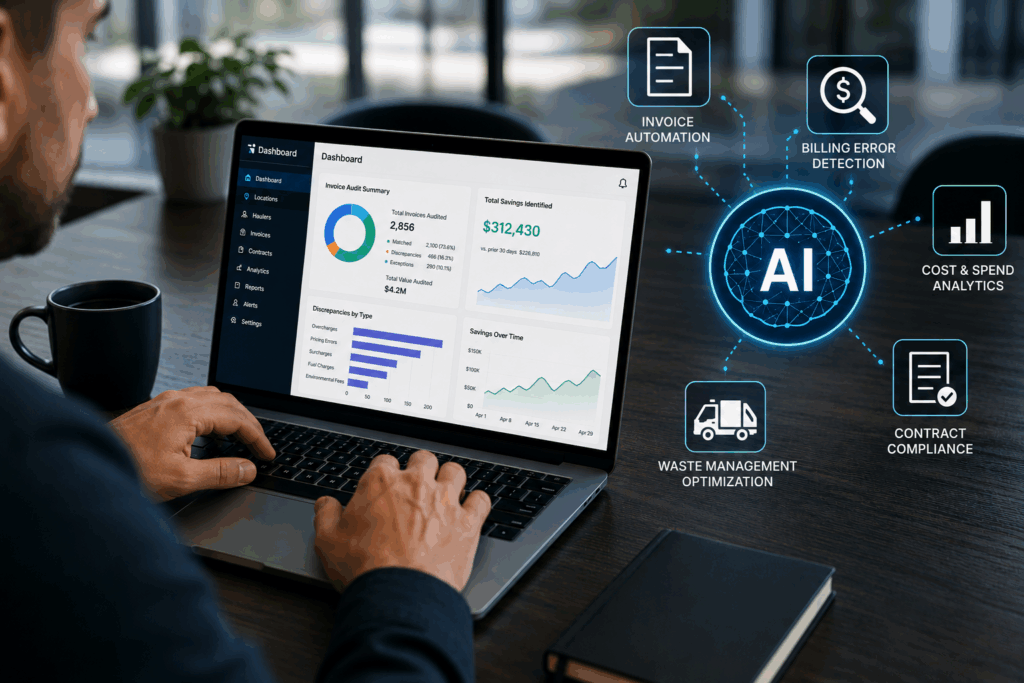
IntellaWaste automates this entire process. The platform automatically imports and parses hauler invoices regardless of format, reads each line item, assigns invoices to the correct customer location using unique identification codes and multi-layer filtering, and makes them immediately available for tracking, auditing, and accounting integration. Customers who previously dedicated large portions of their staff to invoice collection now see that work eliminated — with clients reporting up to a 95% reduction in labor costs associated with invoice processing.
This is not automation in a narrow, brittle sense. It is AI-driven document intelligence that handles the variability and inconsistency inherent in real-world hauler invoicing — including paper invoices that can be scanned and uploaded as batch PDFs — and processes them with the accuracy and consistency that manual review cannot sustain at scale. You can explore the full capabilities of IntellaWaste‘s invoice automation on our products page.
2. AI-Powered Billing Error Detection and Overbilling Identification
If AI invoice processing is the foundation, AI-powered billing error detection is where the real financial impact lives. Every hauler invoice processed through IntellaWaste is automatically verified against the contracted terms for that location — checking rate accuracy, fee legitimacy, service frequency alignment, and contractual escalation compliance in real time, at the moment the invoice arrives.
When a discrepancy is identified — a rate billed beyond contracted terms, an unauthorized fee, a frequency charge that doesn’t match the service level on record — the platform flags it immediately and initiates case management for the price discrepancy. This is critical: the speed of detection determines the outcome. Discrepancies caught immediately can be disputed before payment, preventing the situation where a hauler treats a paid invoice as acceptance of new pricing terms. Discrepancies caught weeks or months later require complex credit negotiations that often result in partial recovery at best.
The hauler billing environment is complex by design. Hauler contracts are typically written to allow specific pricing increases within defined timeframes, percentage-based surcharges with variable triggers, and one-time service fees that are contractually permitted — but only under specific conditions. Auditing all of this accurately, across thousands of invoices monthly, requires the kind of systematic rule-based intelligence that AI is uniquely equipped to provide and that human reviewers simply cannot sustain at volume without error.
For a deep dive into what billing errors actually look like in practice and how much they cost operations that aren’t catching them, our article on waste invoice auditing: what most companies miss covers the most common error patterns and the financial stakes involved.
3. Real-Time Data Visibility and Waste Cost Analytics
One of the most significant gaps in traditional waste management operations is the lack of real-time visibility into what is actually being spent, where, and why. Companies managing waste across multiple locations often have no centralized view of their total waste expenditure, no way to compare spending across locations in real time, and no analytical framework for identifying where costs are above market or where service levels are misaligned with actual waste generation.
This is an AI and data problem — and it is one that waste management technology is now purpose-built to solve.
IntellaWaste provides real-time analytics across all client locations, giving waste brokers, consultants, and corporate operations teams a live view of waste spending, service levels, contract compliance, and overbilling events across their entire portfolio. Service level tracking captures the number of containers, container size, service type, and pickup frequency at every location — and by combining this with invoice data, the platform can report real-time landfill diversion metrics that are increasingly required for corporate sustainability reporting.
For companies managing waste across dozens or hundreds of locations, this kind of data visibility fundamentally changes the decision-making environment. Instead of reacting to invoice problems after the fact, operations teams can see their complete waste cost picture at any moment — identifying outliers, benchmarking performance across locations, and spotting the early indicators of cost creep before they compound into significant overruns. Our article on how to track waste spending across locations explores this capability in depth for multi-site operations.
4. Contract Tracking and Compliance Intelligence
Hauler contracts are long, complex, and designed to be difficult to audit without specialized knowledge. Terms run 12 to 60 months, with pricing escalations, fee structures, and service change provisions embedded in language that makes it easy for a hauler to bill beyond contracted terms and equally easy for a client to miss it.
AI-powered contract tracking changes this dynamic entirely. IntellaWaste maintains all hauler contract terms within the platform and uses them as the continuous verification standard against which every subsequent invoice is audited. Contract expiration dates, escalation triggers, permitted fee categories, and service change terms are all tracked and enforced automatically — so that when a hauler bills for something that exceeds the contract’s terms, the system catches it immediately rather than waiting for a human reviewer to notice an inconsistency months later.
This continuous contract compliance intelligence is particularly valuable in a market where haulers regularly test the boundaries of their contracts with incremental price increases and fee additions that are small enough to fly under the radar of a manual review process but significant in aggregate across a large portfolio of locations.
5. Profitability Intelligence for Waste Brokers and Consultants
For waste brokers and consultants, AI is doing something that was previously very difficult: making profitability visible at the account level, in real time. The margin between what a broker is paying a hauler and what they are charging a client is the fundamental unit of profitability in a brokered waste operation — and yet many brokers have had only limited, lagging visibility into that margin across their portfolio.
When invoices are processed manually and customer billing follows days or weeks later, the opportunity to identify accounts where the margin has eroded — because hauler costs have risen, because the client’s service levels have changed, or because overbilling has gone uncaptured — is largely missed. By the time the problem shows up in a financial report, it has been accumulating for months.
IntellaWaste‘s customer contract monitoring gives brokers and consultants live visibility into the relationship between hauler costs and client billing across every account — identifying margin erosion immediately and providing the data needed to address it before it becomes a profitability problem. For a broader look at the hidden ways companies lose money on waste, our article on how companies overpay for waste services outlines the most common and costly patterns.
6. Accounting Integration and Workflow Automation
The value of AI-powered waste management software is multiplied when it integrates seamlessly with the accounting systems that businesses already use. Manual data entry between a waste management platform and an accounting system is a source of errors, delays, and the kind of duplicated labor that erodes the efficiency gains that automation is supposed to deliver.
IntellaWaste integrates in real time with major accounting platforms — including QuickBooks and NetSuite — importing hauler invoice data directly into the accounting workflow without manual re-entry. The moment an invoice is processed and audited in IntellaWaste, it is available in the accounting system, accurate, assigned to the correct client and location, and ready for client billing. This end-to-end automation — from hauler invoice receipt through audit, discrepancy management, and accounting integration — is what makes it possible for a waste brokerage to scale its portfolio without scaling its administrative headcount proportionally.
Why AI Doesn’t Replace Waste Management Expertise — It Amplifies It
One of the most important things to understand about AI in waste management technology is what it does and does not replace. It does not replace the expertise of an experienced waste broker who knows how to negotiate a hauler contract, understands the local service landscape, and can advocate effectively for a client in a billing dispute. It does not replace the strategic judgment of a waste consultant who can assess a client’s waste stream, recommend service changes, and develop a program that reduces both cost and environmental impact.
What AI replaces is the manual labor that prevents those experts from operating at scale. It replaces the invoice collectors, the spreadsheet auditors, the manual data entry operators, and the after-the-fact discrepancy chasers — freeing the people who actually understand waste management to focus on the work that requires their expertise rather than their time.
This is the model IntellaWaste was built on. The platform was developed by industry veterans who built it specifically to solve the problems they experienced firsthand in waste brokerage and consulting — not as a generic automation tool retrofitted to the industry, but as purpose-built waste management software designed from the ground up to address the specific billing, auditing, and operational challenges that define this business. You can read more about the IntellaWaste story and the team behind the platform on our about page.
The Business Case: What AI-Powered Waste Management Actually Delivers
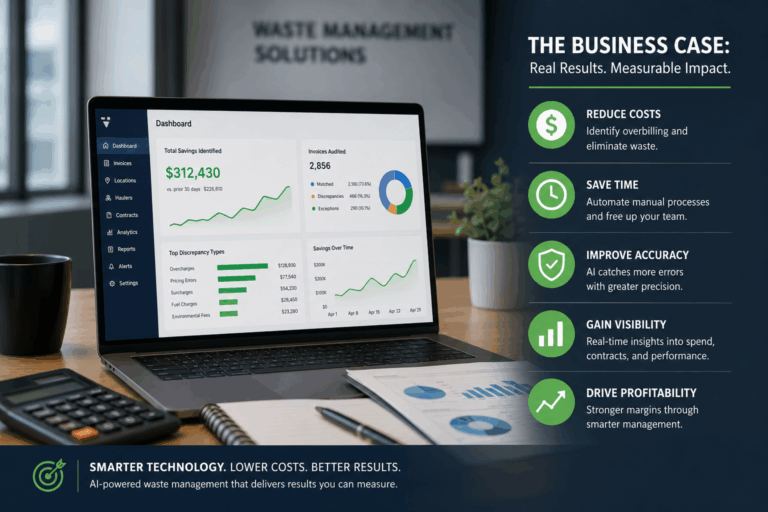
The business case for AI waste management technology is not abstract. The outcomes are measurable, the timeline to value is short, and the cost — particularly at IntellaWaste’s pricing of $5 per location per month with unlimited invoices — is a fraction of what the same capability cost through traditional methods or through the accumulated losses of uncaught overbilling.
What companies implementing AI-powered waste management software consistently experience includes:
- Immediate labor cost reduction — Invoice processing that previously required dedicated staff is automated, with customers reporting up to 95% reductions in time and labor costs associated with invoice management
- Overbilling recovery — Billing errors and price discrepancies that were previously missed or caught too late are identified at the moment of invoice receipt, enabling same-day dispute initiation and credit recovery
- Faster client billing cycles — When hauler invoices are processed automatically and accurately, the delay between invoice receipt and client billing is eliminated — improving cash flow and reducing the operational friction that manual invoice handling creates
- Scalable growth without proportional headcount increase — Brokers and consultants can grow their client portfolios without the administrative bottleneck that previously limited how many locations could be effectively managed
- Real-time profitability visibility — Operations teams can see where they stand financially at any moment, rather than waiting for month-end reports to discover problems that have been accumulating for weeks
Our article on why waste data visibility is broken explores the cost of operating without this kind of real-time intelligence — and what it takes to fix it.
The Competitive Landscape Is Shifting
The adoption of AI in waste management is no longer a forward-looking trend. It is a current reality that is creating a widening gap between the operations that have embraced automation and those that haven’t. Waste brokers and consultants who are still processing invoices manually are operating at a cost disadvantage, catching fewer billing errors, and spending more of their team’s time on administrative tasks — while competitors using AI-powered waste management software are scaling faster, protecting their margins more effectively, and delivering a more consistent, accurate service to their clients.
For corporate waste program managers and CFOs, the question is increasingly not whether to adopt AI waste management technology but which platform to adopt — and how quickly. The companies that have already implemented it are not going back to spreadsheets. And the companies that haven’t yet are leaving money on the table with every invoice cycle that passes.
See What AI-Powered Waste Management Can Do for Your Operation
IntellaWaste processes over 60 million dollars in waste invoices, serves more than 15,000 customer locations, and has identified over $1 million in overbilling events for clients across the United States. The platform is built for waste brokers, consultants, and corporate clients of all sizes — with no minimum location requirement and a pricing model that delivers ROI from the first invoice cycle.
If your operation is still managing waste invoices manually, still catching billing errors after the fact, or still operating without real-time visibility into your waste spending across locations, the technology to change that is available today — and it costs less than you think.
The gap between companies that have adopted AI-powered waste management software and those that haven’t is growing with every invoice cycle. Every month spent on manual auditing is a month of overbilling that goes uncaptured, labor costs that go unreduced, and margin visibility that goes missing. The technology exists today to fix all of it — and seeing it in action takes less than an hour.
Ready to see what your operation looks like when AI is working for you instead of against you? Book a demo with Intellawaste today and find out exactly what you’ve been leaving on the table.
Intellawaste provides waste management software solutions for haulers across the United States.