
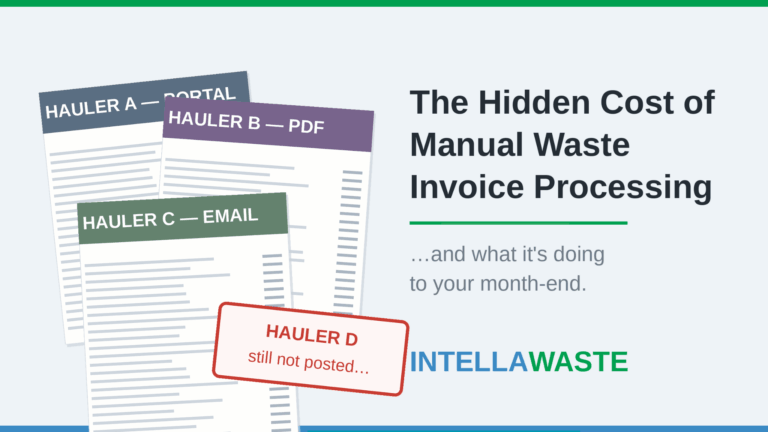
It’s the last week of the month, and somewhere in your office, someone is logging into the eleventh hauler portal of the day. Different login, different layout, different download format. They’ll copy the numbers into a spreadsheet, then key them into your billing system, then do it again tomorrow — because three haulers still haven’t posted their invoices, and until they do, your clients can’t be billed.
If you run a waste brokerage or manage waste for a portfolio of locations, this scene needs no introduction. Manual waste invoice processing is so normal in this industry that most operators have stopped seeing it as a problem and started treating it as the weather. This article puts a price tag on that weather — and explains what waste invoice processing automation actually changes about your month-end.
What Is Manual Waste Invoice Processing Actually Costing You?
The direct answer: manual invoice processing costs waste brokers three ways at once — labor hours spent collecting and keying invoices, billing delays that stretch the month-end close and slow client invoicing, and error rates inherent to manual data entry that leak margin invoice by invoice. Each cost compounds the others: the more invoices you process by hand, the more hours it takes, the later you bill, and the more errors slip through.
What makes the waste industry’s version of this problem unusual is the input side. A broker with 200 client locations might receive invoices from dozens of different haulers — each with its own portal, its own PDF layout, its own line-item conventions, and its own idea of when in the month an invoice should appear. There is no standard. Your team absorbs the chaos manually, every single month.
The Portal Problem: One Invoice at a Time, Dozens of Times
The collection step alone is a hidden full-time job. Hauler invoices arrive scattered across web portals, email attachments, and paper mail — and the portals are the worst offenders: separate credentials for each, sessions that time out, statements published on no particular schedule, and downloads in whatever format the hauler’s system produces.
Run the honest math on your own operation: if collecting, opening, and filing one hauler’s invoices takes even 15 minutes, and you work with 40 haulers across your client base, that’s 10 hours a month spent before a single number has been entered anywhere. For larger brokers, collection alone can consume a person’s entire week — skilled staff doing work a script could do, every month, forever.
Why Can’t Waste Brokers Close the Month on Time?
The direct answer: because a broker’s billing is downstream of every hauler’s billing. You can’t accurately invoice a client until the hauler invoices for their locations have arrived, been entered, and been checked — which means your month-end close runs at the speed of your slowest hauler.
This is the bottleneck that makes waste brokerage month-ends uniquely painful. One missing hauler invoice can hold up an entire client’s bill. Multiply that across a portfolio and the pattern is familiar: client invoicing slides from the 1st to the 5th to the 10th, cash flow stretches, and your team spends the first half of every month reconciling the previous one. Meanwhile, the cost data your account managers need for client conversations is always weeks stale.
The downstream effects reach further than billing. Late closes mean late visibility — into waste spending across locations, into hauler rate creep, into the billing anomalies that an automated waste invoice audit would flag the day the invoice arrives. You can’t analyze data you haven’t finished entering.
The Error Rate Nobody Budgets For
Manual data entry has a failure rate — not because your team is careless, but because keying hundreds of line items from inconsistent documents is exactly the kind of work humans are worst at. Industry studies of manual keying commonly put error rates in the 1–4% range per entry, and waste invoices are an unusually hostile environment: fuel surcharges, environmental fees, franchise fees, overage charges, and tonnage lines that look almost — but not quite — identical month to month.
Every keying error becomes one of two expensive things. An overbilled client, which costs trust and triggers credit memos. Or an unnoticed hauler overcharge passed straight through, which costs margin silently — the duplicate fee, the surcharge that jumped 2%, the container you’re being billed for at a location that closed in March. Manual processing doesn’t just consume hours; it launders hauler errors into your billing.
What Does Waste Invoice Processing Automation Actually Change?
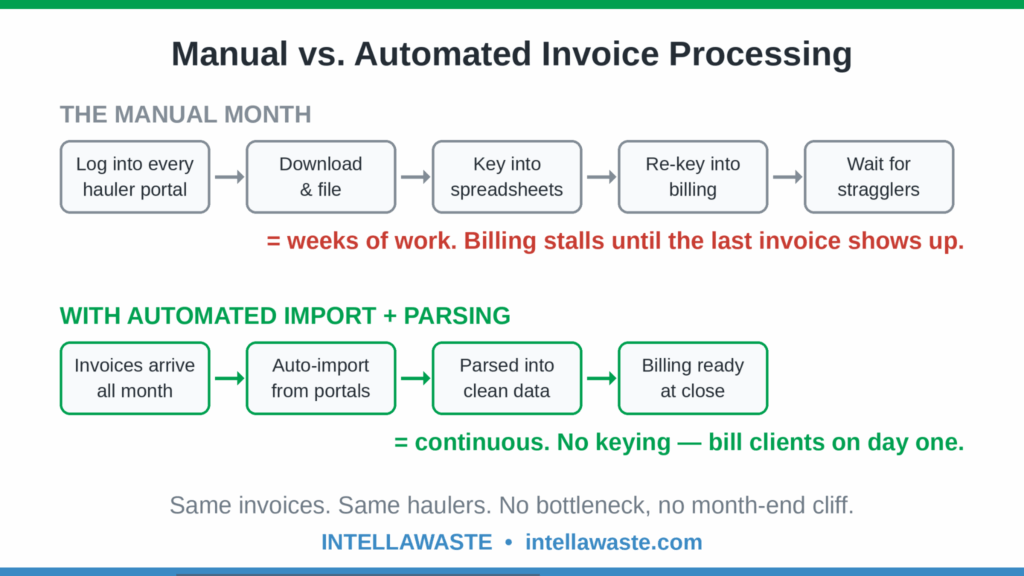
The direct answer: waste invoice processing automation collects hauler invoices automatically, parses the line items into structured data, and loads them into your billing and accounting workflow without manual keying — turning the month-end bottleneck into a continuous process that runs all month long.
Here’s what that looks like in practice with a platform like IntellaWaste:
- Automated invoice import. The system retrieves invoices from hauler portals and inboxes as they’re published — no logins, no downloads, no waiting for someone to make the rounds. The collection job disappears.
- Automated parsing. Line items — haul charges, fuel surcharges, fees, tonnage — are extracted into clean, structured data, the same way every time, regardless of which hauler’s PDF they came from. The keying job disappears, and with it, the keying error rate.
- A rolling close instead of a month-end cliff. Because invoices flow in continuously, client billing is ready when the period ends — not two weeks after. Brokers bill sooner, cash flow tightens up, and the team’s first week of the month stops being archaeology.
- Clean data downstream. Structured invoice data feeds directly into auditing, client reporting, and accounting — including QuickBooks integration, so what’s been parsed once never gets retyped anywhere.
The strategic shift is bigger than the time savings. When invoice data arrives as data — not as PDFs waiting for a human — everything built on top of it gets faster and sharper: audits catch hauler errors while they’re still disputable, margin reporting reflects this month instead of last quarter, and your team’s hours move from data entry to the client-facing work that actually grows a brokerage.
Frequently Asked Questions
What is waste invoice processing automation?
Waste invoice processing automation is software that automatically collects hauler invoices from portals and email, extracts the line-item data (haul charges, surcharges, fees, tonnage), and loads it into a broker’s billing and accounting systems — eliminating manual downloading and data entry.
How does automated invoice import handle different hauler formats?
The parsing engine is built for the waste industry’s reality: every hauler formats invoices differently. It identifies and extracts the same standardized fields from each hauler’s layout, so the output is uniform structured data no matter how inconsistent the inputs are.
Does automated invoice processing work with QuickBooks?
Yes — IntellaWaste integrates with QuickBooks, so parsed invoice data and client billing flow into accounting without re-entry. The goal is that no number is ever typed twice.
How much time does invoice automation save a waste broker?
It depends on invoice volume, but the savings come from three places at once: collection hours across hauler portals, data-entry hours, and the error-correction and reconciliation time that manual keying creates downstream. For most brokerages, that’s measured in entire staff-weeks per month — and a faster close on top of it.
Stop Closing the Month by Hand
The portals, the keying, the waiting, the errors — none of it is a cost of doing business in waste. It’s a cost of doing business manually, and it’s been optional for a while now. If your month-end still runs on logins and spreadsheets, it’s worth seeing what the automated version of your exact workflow looks like — book a demo and bring your messiest hauler’s invoice with you. IntellaWaste provides waste management software solutions for businesses across the United States.