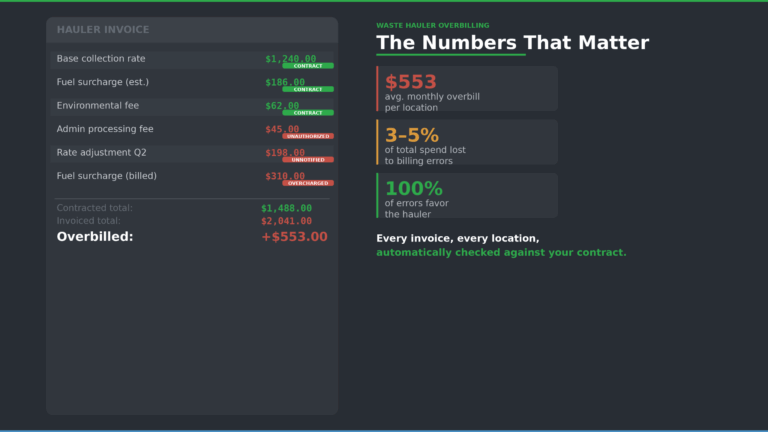
Every month, invoices arrive from waste haulers across your locations. Most of them get approved and paid without serious scrutiny — not because the amounts are verified, but because verifying them manually is too time-consuming to be practical at scale. That is the gap that waste hauler overbilling lives in. It doesn’t require fraud. It doesn’t require bad intent. It simply requires that no one is systematically checking the math.
The industry term for these billing errors is Price Discrepancies, or PDs. They are the difference between what your contract says you should be paying and what you are actually being charged. And across millions of invoices, the pattern is clear: these discrepancies are not random anomalies. They are a steady, predictable drain on waste budgets — and they almost always favor the hauler.
The Four Types of Price Discrepancies
Understanding where overbilling actually comes from is the first step toward catching it. Most PDs fall into one of four categories, each with its own signature and its own dollar impact.
Contract Rate vs. Invoiced Rate
The most fundamental discrepancy is also the most common: the rate on the invoice does not match the rate in the contract. A base collection rate that was negotiated at $1,240 per month gets invoiced at $1,380 with no explanation, no addendum, and no notification that a rate change occurred. At a single location, this might look like a minor rounding issue. Across fifty locations, it becomes a material budget variance that compounds month over month.
Contract-to-invoice rate mismatches happen for a range of reasons — system updates on the hauler’s side, manual billing errors, or rate increases applied broadly without distinguishing contracted customers from non-contracted ones. The cause rarely matters as much as the consequence: money leaving your account that was never authorized to leave.
Unauthorized Rate Increases
Most waste hauler contracts include provisions for periodic rate adjustments — typically tied to CPI (Consumer Price Index) or fuel indices, with a defined cap on how much rates can increase in a given period. What operators find, once they start looking closely, is that actual rate increases frequently exceed these contractual caps. A contract that permits a 3% annual increase gets billed at 7%. A cap that applies to base rates gets applied selectively, leaving surcharges and fees to increase without limit.
The invoiced amount still arrives looking like a normal waste bill. Nothing about the format signals that an unauthorized increase has occurred. Without a system that reads the contract and applies the cap automatically, these increases pass through undetected for months or years.
Surcharge Math Errors
Fuel surcharges and environmental fees are calculated as percentages — but percentages of what? The answer should be in the contract: most agreements specify that surcharges are calculated on the base collection rate only, not on the total invoice. What operators often find when they audit their invoices is that surcharges are being applied to the full invoice amount, including other fees and surcharges themselves. The dollar difference per invoice looks small. Across a portfolio and across twelve months, it is not small at all.
Surcharge calculation errors are particularly difficult to catch manually because they require knowing both the correct calculation base and the correct percentage — two pieces of information that sit in the contract, not on the invoice.
Phantom Services and Unauthorized Fees
The fourth category covers charges for services that either did not happen or were never agreed to. An extra pickup that was not requested. An administrative processing fee that appeared on the invoice without being referenced anywhere in the contract. A container swap charge for an exchange that never occurred.
These line items often appear with vague descriptions that are easy to overlook — “service adjustment,” “account maintenance,” “operational fee” — and their dollar amounts are small enough to survive a quick review. What they share is that they have no contractual basis. They are charges the hauler cannot point to a contract clause to justify, which means they should not be paid.
Why Manual Auditing Fails at Scale
The challenge is not that operators don’t understand the problem — it’s that the traditional response to it doesn’t work. Spreadsheet-based auditing, even when done diligently, has fundamental limitations that allow PDs to persist.
Manual review requires someone to pull the contract for each location, identify the applicable rates and surcharge calculation methods, match them against each line item on each invoice, flag discrepancies, calculate the dollar impact, document the dispute, contact the hauler, track the response, confirm the credit, and close the case. For a business with ten locations and two or three haulers, this is already a significant ongoing workload. For a business with fifty, a hundred, or five hundred locations, it is simply not feasible without dedicated headcount whose entire job is invoice auditing.
The result is that most organizations check what they can, absorb what they can’t, and accept a certain level of overbilling as the cost of doing business with waste haulers. This is the assumption that IntellaWaste was built to challenge.
How PD Case Management Works
The alternative to manual auditing is systematic, automated contract-to-invoice matching — a process where every invoice is checked against its governing contract automatically, every time, without anyone having to pull a spreadsheet or remember which rate applies to which location.
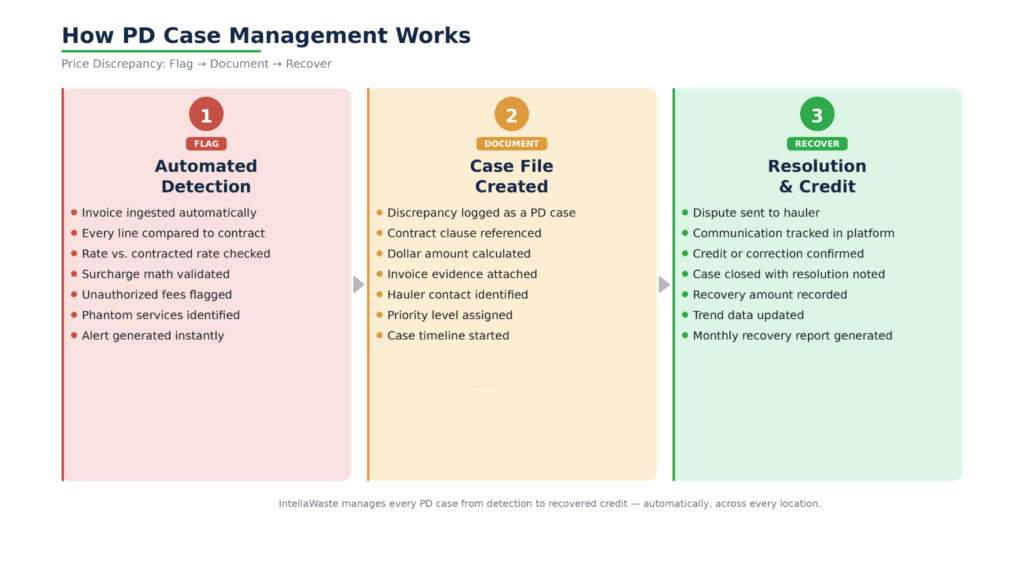
IntellaWaste’s Hauler Overbilling Case Management platform handles this through a three-stage PD workflow:
Flag. Every invoice is ingested automatically and compared line by line against the contract for that location. Rate variances, surcharge calculation errors, unauthorized fees, and charges for services not on the agreement are identified and flagged immediately. No invoice passes through unreviewed. No discrepancy requires a human to notice it before it can be caught.
Document. Each flagged discrepancy becomes a PD case with a full file: the specific contract clause that was violated, the dollar amount of the discrepancy, the invoice evidence, the hauler contact information, and a case timeline. Everything needed to dispute the charge is assembled and organized before anyone picks up the phone. This documentation is what separates a recoverable dispute from one that gets argued in circles and abandoned.
Recover. The dispute is sent to the hauler with the documentation to support it. All communication is tracked within the platform. Credits and corrections are confirmed and logged. Each closed case records its recovery amount, feeding into trend data that shows which haulers generate the most PDs, at which locations, and of which types. Over time, this intelligence shapes smarter contract negotiations and tighter service monitoring.
For organizations managing waste spending across multiple locations, this is the difference between knowing you have an overbilling problem and actually doing something about it at scale.
What Gets Recovered
The dollar question is always the same: is the overbilling significant enough to justify the investment in catching it? The answer, consistently, is yes — and often by a wider margin than operators expect.
Billing errors across a typical multi-location waste portfolio run between 3% and 5% of total waste spend. For an organization spending $500,000 annually on waste, that is $15,000 to $25,000 per year flowing to haulers beyond what was contracted. For larger portfolios, the recovery potential scales proportionally. These are real dollars, already budgeted and already spent, that systematic auditing can claw back.
The asymmetry matters here. When billing errors happen, they almost universally favor the hauler. The math on fuel surcharges is never calculated on too small a base. Rate increases are never applied at less than the contractual cap. Fees for services that didn’t happen never appear as credits. The errors are not random — they have a direction, and that direction is consistently away from your budget.
The Hidden Cost of Dispute Delays
There is a second layer of cost that often goes uncounted: the time between when an overbilling occurs and when it is actually recovered. Manual dispute processes are slow. Identifying the discrepancy, building the documentation, contacting the hauler, following up, confirming the credit — this can take months. During that period, the cash is gone. And in many cases, disputes that take too long simply get dropped because the internal effort required to close them exceeds the perceived value of recovery.
IntellaWaste’s contract compliance and PD management platform addresses this directly by keeping every case visible, documented, and moving. Nothing falls through a spreadsheet. No dispute gets abandoned because someone’s notes were in an email that no one can find. The case file is always current and always accessible, which means disputes close faster and recovery rates are higher.
Beyond Recovery: What PD Data Tells You
The recovery itself is valuable. The pattern data is arguably more valuable. When every PD is documented and tracked, organizations gain visibility into which haulers consistently overbill, what types of discrepancies recur most frequently, and which locations carry the highest billing risk. This is intelligence that directly informs contract negotiations, hauler selection, and service terms.
A hauler who generates five PDs per month at a given location is telling you something about how they manage their billing — information that should be on the table the next time that contract comes up for renewal. A surcharge category that generates the most recovery dollars is a negotiating point, not just a billing line item.
This is the longer-term value of systematic waste hauler overbilling management: it does not just recover money from the past. It creates the data infrastructure to spend less in the future.
If your organization is managing waste spend across multiple locations and relies on manual review to catch billing errors, you are almost certainly leaving money on the table. Book a demo with IntellaWaste to see how automated contract-to-invoice matching and PD case management work in practice — and what your portfolio’s overbilling exposure actually looks like. IntellaWaste turns waste spend from a cost center into a managed, optimized line item your business can actually control.