
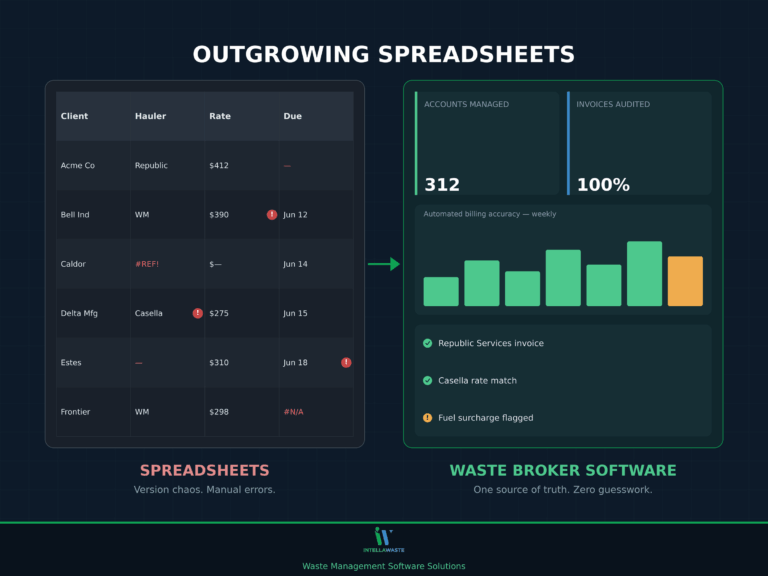
For an emerging waste brokerage, the humble spreadsheet is the ultimate starting point. It is free, completely customizable, and infinitely flexible. When you are managing twenty or thirty accounts, a well-built Excel workbook or Google Sheet can handle the load. You can log hauler names, manually track scheduled pickups, and copy-paste invoice details without too much friction.
But spreadsheets carry a hidden expiration date.
As your brokerage scales from 30 accounts to 100, and eventually past 300, that flexible spreadsheet quietly mutates into a major operational bottleneck. What once took ten minutes now takes an entire weekend. Critical errors start slipping through the cracks, margins shrink, and your staff spends more time fixing broken formulas than winning new corporate accounts.
If your brokerage wants to scale its revenue without forcing you to linearly scale your administrative headcount, you have to hit the growth ceiling of manual data entry and move toward automated waste broker software.
Here is exactly why spreadsheets break down at scale, and how modern systems allow independent waste brokers to protect their margins and accelerate growth.
The Inflection Point: Why Spreadsheets Break at 300 Accounts
When you operate a waste brokerage, you are fundamentally managing a complex web of logistical data. You sit between the commercial client who generates waste and the third-party hauler who services the containers. Every single account represents a moving target of service frequencies, container dimensions, disposal rates, ancillary fees, and contract renewal windows.
When you scale past a few dozen accounts, the spreadsheet architecture begins to collapse under its own weight in four specific ways:
1. Version Control Chaos
When multiple account managers, billing specialists, and operations team members all need access to customer data, spreadsheets become an absolute liability.
- Who has the master copy?
- Did Sarah update the new Republic Services rate increase on the live sheet or her local desktop copy?
- Why did a vital row of historical data suddenly vanish?
When your team relies on static files shared via email or cloud drives, “version chaos” is inevitable. A single accidental keystroke can overwrite a complex pricing formula, corrupting months of billing data without anyone noticing until a client complains about an overcharge.
2. The Silent Killer: Missing Contract Alerts
Waste brokerage profitability hinges entirely on your ability to catch contract expiration windows—both on the client side and the hauler side.
Spreadsheets are completely passive. They will not send your team an automated alert when a massive multi-location client enters their 60-day non-renewal window. They will not warn you when a hauler’s automatic price escalation clause is about to kick in. When you miss these critical dates, you lose your leverage to renegotiate rates, resulting in immediate margin erosion or lost business to faster, tech-enabled competitors.
3. Manual Invoicing and Audit Trail Gaps
At 30 accounts, generating monthly invoices manually is a chore. At 300 accounts, it is an administrative nightmare that delays your cash flow.
Your team must manually log into various hauler portals, extract the disposal tickets, cross-reference them against agreed-upon client contract rates, look out for unexpected ancillary fees (like fuel surcharges or overage penalties), and type out an invoice. Because spreadsheets lack an unalterable audit trail, tracing an invoicing error back to its source requires hours of forensic data digging, pulling your best people away from revenue-generating tasks.
What Comes Next: Automatic Operational Efficiency
To break through the spreadsheet growth ceiling, modern brokerages transition to specialized, cloud-based software explicitly engineered for the waste industry. Instead of trying to bend generic accounting tools to fit a highly unique logistics model, modern platforms integrate your entire operation into a single, cohesive hub.
Moving away from spreadsheets changes your business in three major areas:
Single Source of Truth
Instead of scattering information across disparate files, every client contract, hauler rate sheet, active service ticket, and historical invoice lives in one central dashboard. When an account executive updates a client profile, the billing department sees it instantly. There is no duplicate data entry, no missing files, and zero version confusion.
Automated Exception Billing
Instead of manually auditing every single line item on every incoming hauler invoice, waste broker software automates the entire auditing workflow. The system instantly cross-references incoming hauler bills against your digital contract rates. If a hauler tries to sneak in an unauthorized contamination fee or an unexpected fuel surcharge escalation, the software automatically flags the discrepancy for review. Your team only spends time handling the specific exceptions, completely eliminating manual invoice creation.
Proactive Contract Management
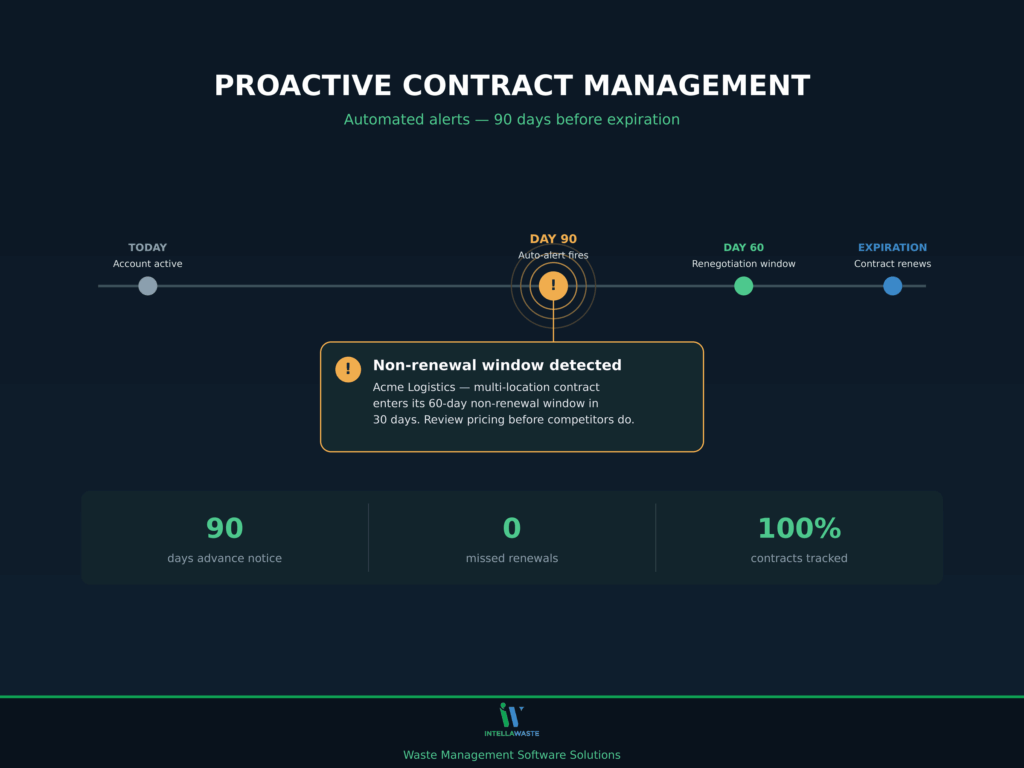
Modern operational platforms turn passive columns of dates into highly active workflows. The system automatically alerts your management team 90 days out from any client or hauler expiration window. This gives you the runway needed to audit the account’s historical data, calculate optimization opportunities, and approach the client with proactive savings before a competitor tries to poach the business.
Scale Revenue Without Scaling Headcount
The ultimate goal of replacing spreadsheets with dedicated software isn’t just about reducing stress—it is about fundamentally changing the financial trajectory of your brokerage.
In a traditional spreadsheet-driven brokerage, your operational costs scale linearly with your revenue. If you want to double your active accounts, you are forced to double your administrative staff just to keep up with the overwhelming mountain of manual data entry, invoice cross-referencing, and phone-based customer service. This traps your business in a low-margin loop.
By implementing Intellawaste’s proprietary systems, your brokerage breaks free from that linear constraint. Because automation handles the tedious invoice auditing, contract tracking, and multi-location reporting, a lean team of three or four operators can easily manage hundreds of commercial accounts with pinpoint accuracy.
You unlock true operational leverage: your revenue climbs exponentially while your back-office overhead remains completely flat.
Let’s Clean Up Your Operations
If you are tired of fighting broken Excel formulas, missing out on critical contract renewals, and spending your weekends manually building customer invoices, it is time to upgrade your tech stack.
At Intellawaste, we help independent waste brokers digitize their operations, protect their margins, and build a highly scalable business model. Contact us at www.intellawaste.com today to see how our waste industry solutions can replace your messy spreadsheets with automated efficiency.