
The best waste management software is not the platform with the longest feature list or the most impressive dashboard. It is the system that can take the work your team performs every month—collecting invoices, checking charges, tracking contracts, resolving discrepancies, billing clients, updating accounting records and reporting results—and connect it without creating another layer of manual data entry.
That distinction matters because waste data rarely arrives ready for analysis. Invoices may be spread across hauler portals, email attachments, scanned documents and different formats. Contracts may sit in separate folders. Service changes may live in email threads. If the software cannot organize that information at the point of entry, every downstream feature depends on employees cleaning and re-keying data first.
For waste brokers and consultants, the right platform should also support client billing, profitability and repeatable service delivery. For multi-site operators, it should create a reliable portfolio view across locations, haulers, contracts and service levels. This guide explains what to evaluate, what to ask and what a realistic implementation should include.
Start With the Workflow, Not the Dashboard
A polished dashboard can summarize data, but it cannot repair an incomplete operating process. Begin by mapping how an invoice moves through your organization today: where it arrives, who verifies it, how an exception is handled, when a client invoice is created, how the transaction reaches accounting and what leadership eventually sees.
Then ask each vendor to demonstrate that complete sequence. A system that performs one step well but requires spreadsheets, duplicate entry or disconnected tools between steps may simply move the bottleneck.
The Seven Capabilities the Best Waste Management Software Should Cover
1 Automated Invoice Collection and Parsing
Invoice ingestion is the foundation. Ask how the platform handles portals, emailed PDFs, batch uploads and scanned paper invoices. It should extract line-item data, assign each invoice to the correct client and location, retain the original document and make the structured information available to the rest of the workflow.
Do not accept “we use automation” as the answer. Request a live demonstration using several invoice formats that resemble your actual hauler mix. Ask how exceptions, unreadable pages, duplicate invoices and changed portal credentials are handled.
2 Audit Coverage Across the Full Invoice Population
Manual teams often review only large or unusual invoices because complete coverage is too labor-intensive. Software should make it practical to apply defined checks to every invoice, including contracted rates, permitted increases, percentage-based charges, service quantities, recurring fees, credits and location status.
The key question is not whether the platform has an “audit” feature. Ask which fields it compares, what contract data must be configured, how rules are updated and how users review exceptions without being buried in false positives. For a practical list of invoice checks, IntellaWaste’s Waste Invoice Audit Checklist.
3 Price Discrepancy Case Management
Finding a possible overcharge is only the beginning. A price discrepancy, or PD, needs an owner, supporting documents, status, communications, disputed amount and final outcome. The platform should preserve the connection between the invoice, controlling contract term, investigation and credit or rate correction.
Ask whether users can separate suspected, validated, disputed, credited and closed items. Also confirm whether the system checks future invoices to determine whether a correction actually held.
4 Contract Monitoring and RFP Tools
A contract repository is useful only if it turns dates and terms into action. The system should track start dates, expirations, auto-renewal provisions, notice deadlines, permitted increases and service details. Alerts should arrive early enough for a negotiation or competitive bid.
RFP tools should build service specifications from current location data, organize vendor responses and support comparable bid analysis. See IntellaWaste’s Waste Management RFP Process guide.
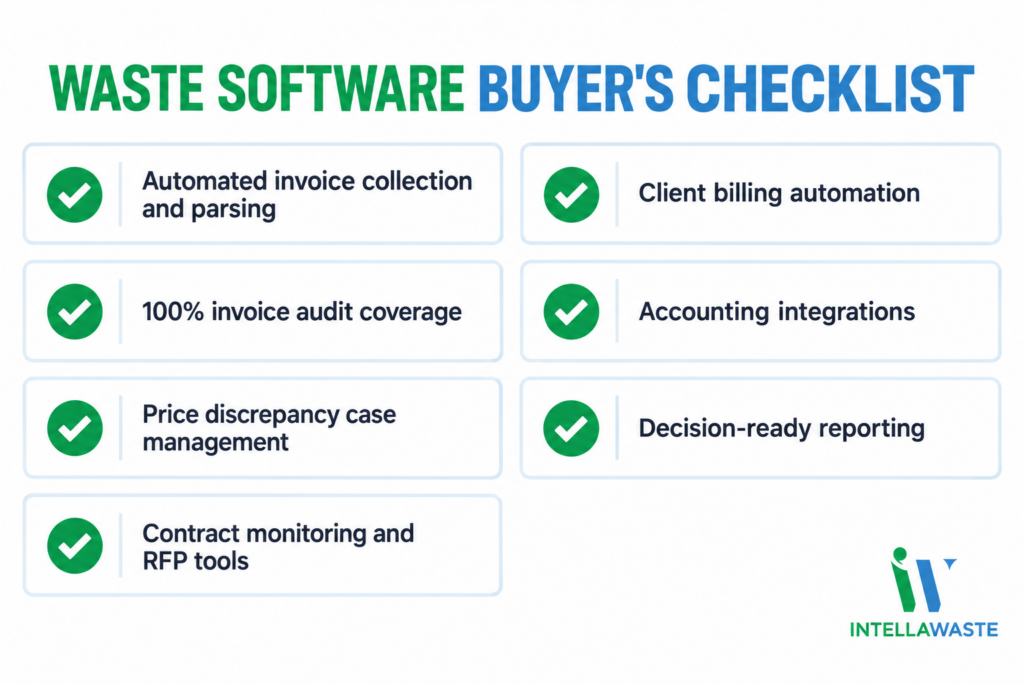
5 Client Billing Automation
For brokers and consultants, hauler invoice processing and client billing are connected. The software should apply the correct client terms, handle approved ancillary charges and produce reviewable client invoices without requiring employees to re-key the hauler data.
Ask how the system handles exceptions, pass-through charges, markup rules, credits and different client arrangements. Automation should shorten the cycle while preserving human approval where the business requires it.
6 Accounting Integrations
An accounting integration should eliminate duplicate entry, not hide it behind an export button. Confirm which platforms and versions are supported, how customers, locations, vendors, accounts and classes are mapped, and what happens when a transaction fails validation.
Ask about duplicate prevention, reconciliation, correction workflows and the audit trail back to the original invoice. IntellaWaste supports real-time hauler invoice imports into accounting software; buyers should still validate the exact workflow for their accounting environment.
7 Reporting Built on Traceable Data
Reporting should answer operating questions, not simply display totals. Buyers should be able to review spend by location, hauler and charge category; cost and service trends; open discrepancies; recovered credits; contract deadlines; and broker profitability or client-facing results where applicable.
Every important total should be traceable to the supporting line items and original documents. That is what separates decision-ready reporting from a polished summary that still requires days of research.
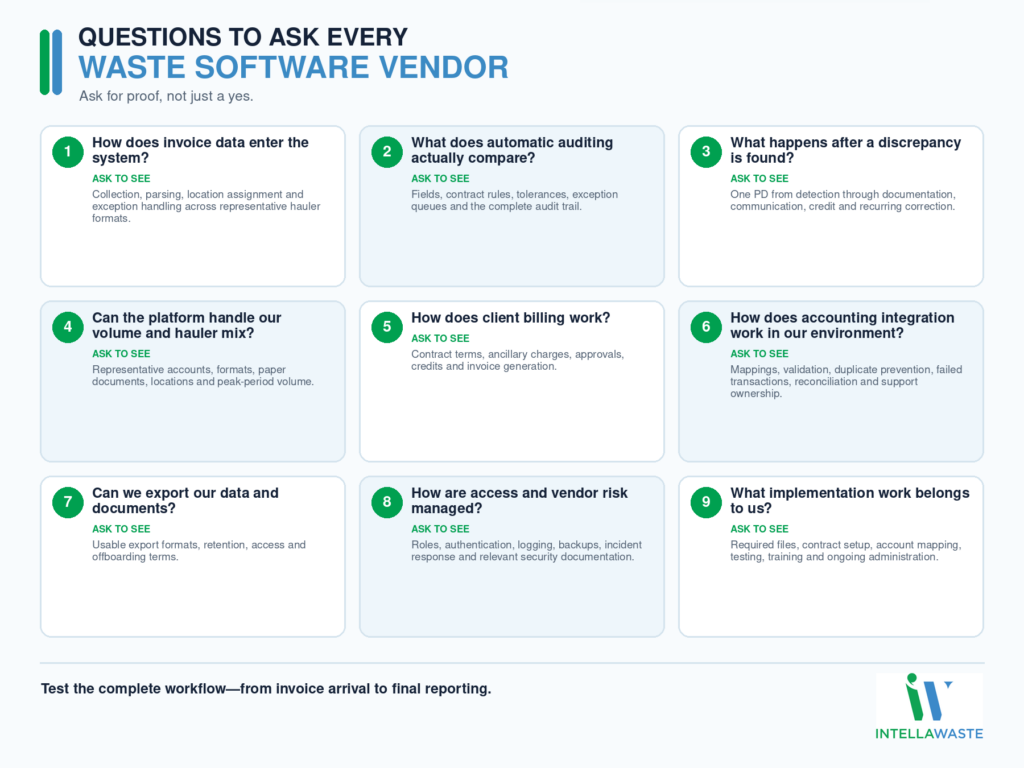
Questions to Ask Every Waste Software Vendor
Use questions that require the vendor to show evidence. A confident “yes” is less valuable than a demonstration with your data.
Do Not Skip Security, Access and Data Ownership
Waste software may contain invoices, contracts, customer records and accounting information. Include information security and vendor-risk review in the buying process. Ask how access is controlled, whether activity is logged, how data is backed up, what incident-notification commitments apply and how your information can be exported at the end of the relationship.
The National Institute of Standards and Technology’s Cybersecurity Framework and supply-chain risk guidance both emphasize managing cybersecurity risk associated with technology providers. The depth of review should match your organization’s risk, data and integration requirements; it should not be replaced by a generic security statement.
What a Realistic Implementation Should Include
Implementation time depends on the number of locations, haulers, contracts, invoice formats, accounting mappings and the condition of existing data. Instead of accepting a universal timeline, ask the vendor for a plan based on your environment.
Discovery and data mapping: document clients, locations, haulers, services, contracts, invoice sources, billing rules and accounting fields.
Representative pilot: test a meaningful mix of digital, scanned, simple and complex invoices before a full rollout.
Validation: compare parsed fields, audit results, generated billing and accounting output with known source documents.
Controls and ownership: define who reviews exceptions, approves billing, resolves PDs, maintains contract terms and monitors integrations.
Training and support: train each role on its daily work, document escalation paths and agree on launch and post-launch responsibilities.
Success measures: establish a baseline for invoice completeness, processing time, audit coverage, unresolved discrepancies, billing cycle time and manual touches.
A successful rollout does not merely turn on software. It establishes a reliable operating process and shows that the outputs match the source documents.
How to Make the Final Decision
Score each platform against your actual workflow and give the most weight to the steps that create reliable data. A practical sequence is invoice collection and parsing first, auditing second, client billing and accounting flow next, contract and RFP management after that, and reporting built on top of the connected record.
Request a demonstration that follows one real-world example from invoice arrival to final reporting. Include users from operations, finance, procurement and—if applicable—client billing. Record open questions, required configuration and any remaining manual handoffs.
IntellaWaste is built for waste brokers, consultants and corporate teams managing waste and recycling across multiple locations. Its published capabilities include automatic invoice uploads and parsing, invoice auditing, hauler and customer contract monitoring, service-level tracking, PD case management, accounting imports, automatic billing for brokerage and consulting customers, financial reporting and RFP management.
Ready to evaluate the workflow with your own requirements? Schedule an IntellaWaste demo and ask the team to walk through the complete process—not just the dashboard.
Frequently Asked Questions
What is waste management software?
Waste management software organizes operational and financial information such as hauler invoices, contracts, locations, service levels, billing exceptions and reporting. Platforms vary widely, so buyers should distinguish general hauling or routing software from systems designed for brokers, consultants and multi-site waste spend management.
What makes the best waste management software for a broker?
A brokerage platform should support automated hauler invoice intake, contract-based auditing, PD case management, client billing, accounting integration, customer contract monitoring, profitability reporting and workflows that can scale across many clients and locations.
Is general accounts payable automation enough for waste invoices?
General AP automation may capture and route invoices, but it may not understand waste-specific service levels, contract increases, surcharges, ancillary charges, client billing rules or RFP timing. Buyers should test whether a general system can perform the domain-specific checks they need or must be paired with a waste-focused platform.
How long does waste management software implementation take?
There is no responsible one-size-fits-all answer. Timing depends on account volume, hauler mix, contract availability, invoice formats, billing complexity, integrations and data quality. Ask for a scoped plan with pilot, validation, rollout, training and measurable acceptance criteria.