

A competitive bid does not lower waste costs because several haulers submit prices. The result depends on the quality of the scope, the accuracy of the underlying service data, and whether every bidder prices the same requirements.
That is why an effective waste management RFP process begins well before the RFP is sent. The work starts with understanding what each location actually receives, what it uses, what it pays, and when the existing contract can be changed or terminated.
For a multi-site company or a broker managing an entire client book, the difference between a useful RFP and a confusing one is structured data. Current service levels, invoice history, contract dates, and site requirements make the process easier to repeat and the responses easier to compare.
When Should You Run a Waste Hauling RFP?
Not every account needs to be sent to market every year. A waste hauling RFP makes the most sense when there is a clear commercial or operational reason to test the market.
Common triggers include:
- A contract is approaching expiration. The RFP timeline must account for any advance notice requirement and give the team enough time to solicit bids, negotiate terms, make an award, and coordinate a transition if the provider changes.
- A site is out of contract. An out-of-contract location may offer an immediate opportunity to establish competitive pricing and clearer service terms.
- The operation has changed. Store openings or closures, new waste streams, compactor installations, seasonal volume shifts, recycling goals, or persistent overflow can make the old service plan obsolete.
- The current price no longer matches the service. A price increase is not the only reason to review an account. A location may also be paying for too much capacity, too many pickups, or services it no longer uses.
- A portfolio has grown. Newly acquired or decentralized locations may use different haulers, fee structures, and contract terms. A coordinated RFP can reveal opportunities for a more consistent scope or stronger purchasing leverage.
The decision should still be made account by account. The purpose is not to force a switch; it is to create a documented comparison and an informed negotiating position.
Step 1: Build the RFP From Actual Service and Volume Data
The most expensive RFP mistake often occurs before a single hauler is invited: the buyer sends bidders an inaccurate picture of the work.
An old contract may show what was originally ordered, but it may not reflect today’s container count, pickup frequency, material streams, tonnage, overflow pattern, or temporary services. Likewise, a single recent invoice may include an unusual extra pickup or miss a seasonal volume change.
Before drafting the scope, create a baseline for every location included in the bid:
- Site name and complete service address
- Waste stream, such as municipal solid waste, cardboard, mixed recycling, organics, or construction debris
- Container or equipment type, size, and quantity
- Scheduled pickup frequency and current service days
- Compactor haul frequency, if applicable
- Recent volume, weight, or pull history when available
- Current recurring rate and disposal pricing method
- Fuel, environmental, regulatory, administrative, and other recurring fees
- Extra pickup, dry-run, contamination, overage, delivery, removal, and exchange charges
- Known access restrictions, enclosure dimensions, gate hours, or site-specific instructions
- Contract expiration date, renewal language, and cancellation notice window
The U.S. Environmental Protection Agency’s nationwide waste management guide for commercial buildings recommends tracking the amount and types of waste an organization generates. The EPA notes that this data can help offices, stores, hotels, restaurants, schools, and other organizations negotiate services that fit their needs.
For most commercial portfolios, several months of invoices and service activity provide a more reliable baseline than the existing agreement alone. A facility walk-through may reveal changing volume or contamination that billing records do not show. The EPA identifies records reviews, facility walk-throughs, and waste sorts as common waste-assessment methods. The goal is to bid the service the locations need next—not preserve historical inefficiency.
Step 2: Define the Scope So Haulers Price the Same Job
Once the baseline is verified, turn it into a clear bid specification. Every hauler should receive the same location list, service requirements, pricing template, instructions, and response deadline.
A commercial waste RFP should address more than the monthly base rate. The scope may include:
- Required containers, equipment, and collection frequencies
- Accepted service-day windows and holiday procedures
- Disposal and processing assumptions
- Pricing for recurring, variable, and one-time services
- Rules for annual increases and pass-through charges
- Missed-pickup response expectations
- Reporting and invoice-detail requirements
- Customer service contacts and escalation procedures
- Insurance, licensing, and safety requirements
- Equipment delivery, transition, and removal responsibilities
- Initial contract term, renewal structure, and termination language
- References and disclosure of material exceptions to the scope
Be specific where consistency matters, but allow clearly labeled alternatives when a hauler can propose a more efficient service design. Keep alternatives separate from the required base bid so they do not interfere with the primary comparison.
Review final RFP and contract language under the organization’s procurement policies and with qualified legal counsel where appropriate.
Step 3: Run the RFP Online and Keep One Record
Email chains and spreadsheets become difficult to control across many clients, markets, and contract dates. Documents get duplicated, responses arrive in different formats, and bid history becomes unclear.
An online waste management RFP process provides a consistent place to create, distribute, and retain the bid record: identify eligible accounts, verify the service data, generate the RFP, send it to selected haulers, and keep the records together.
IntellaWaste’s documented RFP functionality is built for this use case. Its online RFP generator allows brokers and consultants to identify expired contracts, create and send RFPs to haulers, and retain the process in a centralized section. IntellaWaste also lists RFP management, contract monitoring, service-level tracking, invoice parsing, and invoice auditing among its platform capabilities.
Software does not replace procurement judgment. It does remove avoidable administrative friction and creates a more reliable operating record.
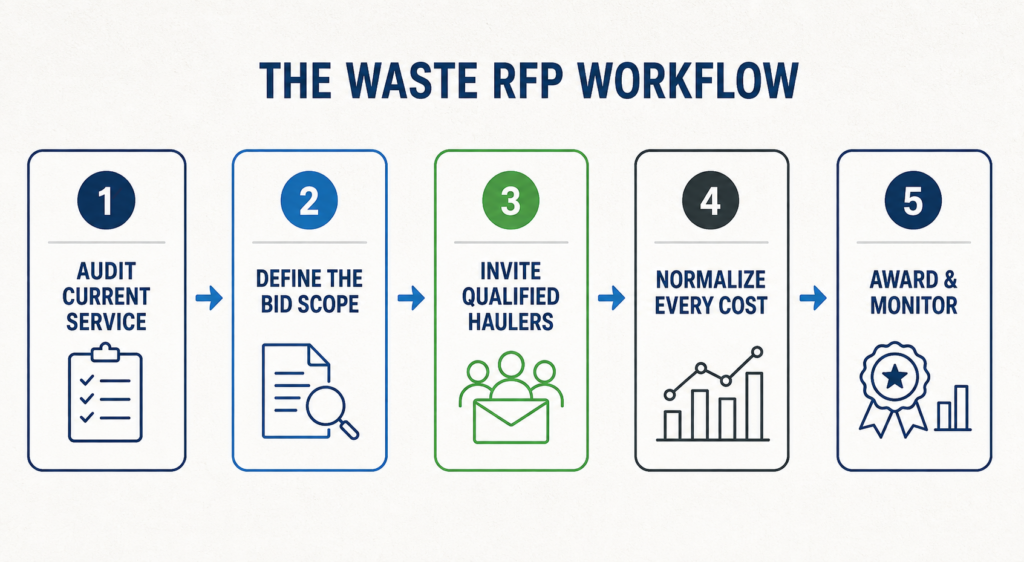
Step 4: Compare Apples to Apples—Including Every Material Cost
The lowest quoted monthly rate is not necessarily the lowest evaluated cost.
One bid may include fuel and environmental charges in the base rate while another lists them separately. Disposal may be quoted by the ton, by the haul, or with a weight allowance. Annual escalation language can also change the economics after the first year.
Normalize every proposal into the same cost categories:
| Cost category | What to compare |
|---|---|
| Recurring service | Monthly rate by location, stream, container, and frequency |
| Disposal or processing | Included allowance, per-ton rate, minimums, and facility assumptions |
| Recurring fees | Fuel, environmental, regulatory, administrative, franchise, or similar charges |
| Exception charges | Extra pickups, dry runs, contamination, blocked access, overage, and wait time |
| Equipment and transition | Delivery, installation, exchange, removal, locks, casters, and enclosure work |
| Price changes | Fixed increases, index-based adjustments, caps, floors, and pass-through provisions |
| Contract structure | Initial term, renewal method, notice period, termination rights, and damages |
Calculate expected cost over the evaluation period using the same operating assumptions. If variable costs cannot be predicted precisely, show multiple scenarios.
This is also where non-price exceptions matter. A low rate loses value if the proposal excludes a required location, assumes different service frequencies, limits reporting, or reserves broad rights to add charges later.
Step 5: Score Service Capability Separately From Price
The cheapest bid is not always the best operational fit. At a high-volume site, one missed pickup can erase the difference between two monthly rates.
Use a scorecard that reflects the account’s priorities. Typical non-price factors include:
- Coverage across the required markets
- Experience with similar locations and equipment
- Ability to meet service-day and access requirements
- Customer service and escalation process
- Reporting and invoice detail
- Transition plan and implementation timing
- References and documented service history
- Sustainability, diversion, or material-tracking capabilities when required
- Acceptance of the proposed commercial and contract terms
For complex multi-location bids, minimum qualifications can be scored on a pass/fail basis before price is considered. If first-round proposals reveal an ambiguous requirement, the buyer can clarify the scope and request revised pricing from every affected bidder, provided the same information and opportunity are given consistently.
Establish scorecard weights before opening responses.
Step 6: Turn the Winning Bid Into a Managed Contract
An RFP is only successful if the awarded terms survive implementation.
After selection, reconcile the winning proposal, negotiated changes, final service schedule, and signed agreement. Resolve any conflict among those documents before service begins. Then place the final rates, authorized fees, effective dates, escalation rules, and contract deadlines into the same management workflow used for invoices and service levels.
This closes the loop:
- The RFP defines what should be delivered.
- The contract records what was awarded.
- The service record shows what is scheduled.
- The invoice shows what was billed.
- Ongoing auditing identifies where those records do not agree.
Without that connection, negotiated savings can erode through incorrect rates, unauthorized fees, missed service changes, or an overlooked renewal deadline.
How Waste Brokers Scale the RFP Process Across a Client Book
For a broker managing hundreds or thousands of locations, the challenge is identifying eligible accounts, gathering accurate data, executing bids consistently, and retaining the results for contract and invoice management.
That requires a repeatable data model. Contract dates identify the opportunity. Service levels define the scope. Parsed invoices help establish current cost and volume. Standard templates and centralized records preserve the bid and awarded terms.
IntellaWaste was designed for waste brokers, consultants, and large multi-site organizations. Its combination of contract monitoring and service-level tracking with online RFP management allows the bid process to become part of everyday account management rather than a separate manual project.
A Better Bid Begins With Better Data
The strongest waste management RFP process does not begin with the question, “Who will give us the lowest price?” It begins with three more useful questions:
- What service do these locations actually need?
- What will each proposal cost under the same assumptions?
- How will we make sure the awarded terms are followed?
When those answers are supported by accurate service, contract, and invoice data, competitive bidding becomes more than a price exercise. It becomes a practical tool for controlling costs, improving service accountability, and managing waste contracts at scale.
Book an IntellaWaste demo to see how contract monitoring, service-level tracking, invoice intelligence, and online RFP management can work together in one platform.