
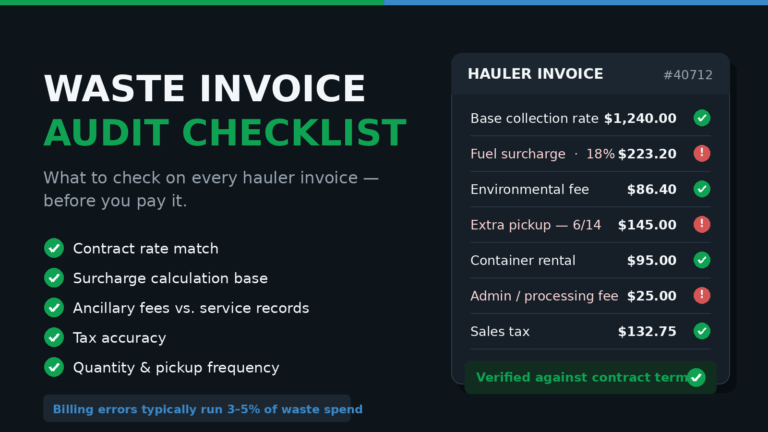
Most hauler invoices get about thirty seconds of attention. Someone confirms the total looks roughly like last month’s, codes it to the right GL account, and moves on. That thirty-second review is exactly what haulers’ billing systems are calibrated against — and it’s why billing errors typically run 3–5% of total waste spend, month after month, without anyone noticing.
The fix isn’t paranoia. It’s a repeatable waste invoice audit checklist — a short list of specific things to verify on every invoice before it gets paid. This article walks through that checklist item by item: what to pull, what to compare, and what a discrepancy looks like when you find one. Then we’ll be honest about the hard part — actually running this checklist at scale — and what it looks like when software does it for you.
Before You Start: Three Documents You Need
An invoice can’t be audited against itself. Every check below compares the invoice to an outside source of truth, so before you begin, pull together:
- The hauler contract for that location — including addendums and any rate-increase notices. This is where contracted rates, allowed increase caps, surcharge terms, and permitted fees live.
- Service records — pickup logs, work orders, driver tickets, or your own site records. This is how you verify that billed services actually happened.
- The previous two or three invoices — for trend comparison. Many errors are only visible as month-over-month drift.
If you can’t locate the current contract for a location, that’s a finding in itself — and a common one. You cannot enforce terms you can’t produce.
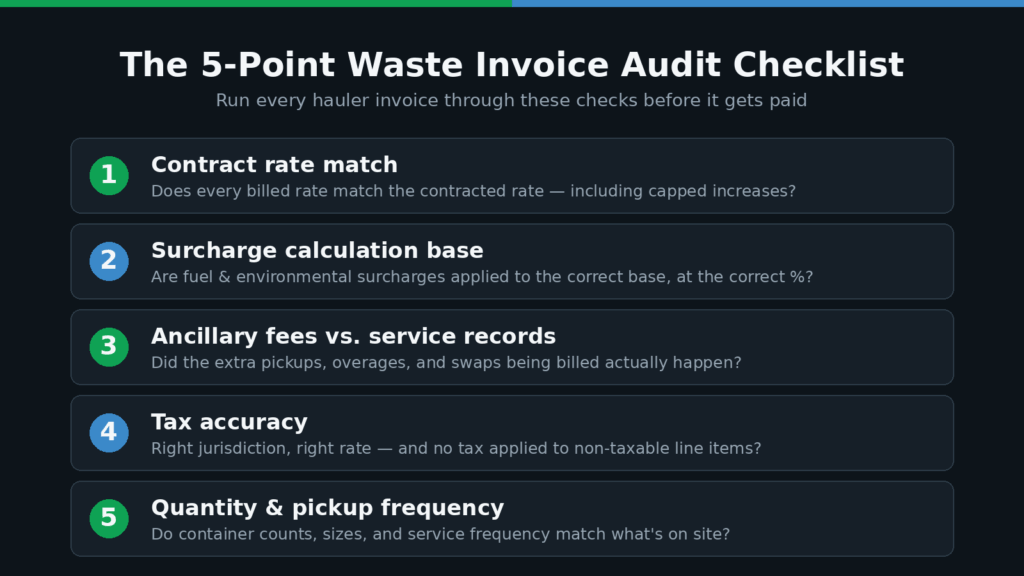
The 5-Point Waste Invoice Audit Checklist
1. Match Every Rate Against the Contract
Start with the base collection rate — the largest recurring number on the invoice — and compare it directly to the rate in the contract, not to last month’s invoice. Comparing to last month only tells you whether the rate changed; comparing to the contract tells you whether it’s correct. A rate that drifted upward eight months ago will pass the month-over-month test forever.
While you’re there, check any rate increase against the contract’s escalation terms. Most agreements cap increases — often tied to CPI, with a defined percentage ceiling and a defined frequency. Verify three things: that an increase was contractually permitted at all, that it stayed under the cap, and that it was applied on the allowed schedule. Increases that exceed contractual caps are one of the most common and most expensive discrepancies in the industry, and catching these price discrepancies is where audits recover the most money.
2. Check the Surcharge Calculation Base — Not Just the Percentage
Fuel surcharges and environmental fees are percentages, and the percentage is only half the check. The question that matters is: a percentage of what? Most contracts specify that surcharges apply to the base collection rate only. In practice, surcharges are frequently calculated on the full invoice amount — including other fees, and sometimes including other surcharges. Surcharge-on-surcharge math is a small number on any single invoice and a large number across a year.
To run this check: take the contract’s surcharge percentage, multiply it by the contractually defined base, and compare your result to the billed amount. If the billed surcharge is higher, work backwards to find what base was actually used. Also confirm the percentage itself matches the contract or the hauler’s published index — surcharge percentages have a way of quietly ratcheting up a point or two.
3. Verify Ancillary Fees Against Actual Service Records
Extra pickups. Overage charges. Contamination fees. Container swaps. Lock and gate fees. These line items share two traits: they’re billed as one-off events, and they’re almost never verified. That combination makes them a reliable home for charges with no basis in reality.
For each ancillary charge, ask two questions. First, did it happen? Cross-reference the charge against your service records — a $145 extra pickup on the 14th should correspond to an actual extra pickup on the 14th, ideally one your site requested. Overage and contamination fees deserve particular skepticism, since they’re often assessed on the driver’s judgment with no photo or documentation. Second, is it allowed? Vague line items like “service adjustment,” “administrative fee,” or “account maintenance” should trace to a specific contract clause. If the hauler can’t point to one, the charge shouldn’t be paid.
4. Confirm Tax Accuracy
Taxes get skipped in most manual audits because they look like an untouchable government number. They’re not — they’re a calculation, and calculations have errors. Check three things: that the tax rate matches the correct jurisdiction for the service location (a real issue for multi-location businesses, where a hauler’s billing system may apply one region’s rate portfolio-wide), that tax is only applied to taxable line items (waste service taxability varies by state, and fees or surcharges are sometimes taxed when they shouldn’t be), and that any franchise fees or government-mandated charges match the actual local ordinance rather than a rounded-up approximation.
5. Verify Quantities and Pickup Frequency
Finally, check that what’s being billed matches what’s physically on site and actually being serviced. Confirm the container count and container sizes on the invoice against reality — being billed for an 8-yard container when a 6-yard sits on the pad is a permanent, compounding overcharge. Confirm the pickup frequency: a location billed for three pickups per week that receives two is paying roughly 50% more per actual pickup than it agreed to. And watch for services at locations that have closed, downsized, or changed their service level — “phantom” service billing routinely survives for months after a change because nobody reconnects the invoice to the site.
This check matters beyond error recovery: it’s also how you spot over-servicing. If containers are going out half-full, the invoice is technically accurate — but the service level is wrong, and that’s money too. For a deeper look at what slips past even well-run review processes, see our guide to what most companies miss in waste invoice auditing.
The Honest Problem: This Checklist Doesn’t Scale
Run properly, the checklist above takes 20–40 minutes per invoice — pulling the contract, doing the surcharge math, cross-referencing service records, checking the tax treatment. For a single location with one hauler, that’s a manageable monthly habit. For ten locations, it’s a real workload. For fifty or five hundred locations across a dozen haulers with a dozen different invoice formats, it is a full-time job that most organizations never staff — which is why most organizations audit a sample, or audit nothing, and absorb the 3–5% as a cost of doing business.
The math gets worse when you find something. A flagged discrepancy still has to be documented, disputed with the hauler, tracked through weeks of follow-up, and confirmed as a credit. Manual disputes die in inboxes constantly — not because they’re wrong, but because the effort of pursuing them exceeds the value of any single line item. The hauler doesn’t have to win the argument; they just have to outlast your attention span.
What Running This Checklist Automatically Looks Like
Every check described above is a comparison between structured data points: invoice rate vs. contract rate, billed surcharge vs. calculated surcharge, billed service vs. recorded service. That makes it exactly the kind of work software should be doing — the same checklist, applied to 100% of invoices instead of a sample, in seconds instead of half an hour.
That’s how IntellaWaste works. Invoices are imported and parsed automatically, each contract’s rates, caps, surcharge terms, and permitted fees live in the platform, and every invoice is audited against its contract line by line the day it arrives. When something fails a check, it doesn’t just get flagged — it becomes a documented price discrepancy (PD) case with the contract clause, the dollar amount, and the evidence attached, tracked through to credit recovery so disputes stop dying in inboxes. Across multi-location portfolios, the same data powers spend tracking and benchmarking across every site, so patterns — the hauler who always overbills, the location that’s always over-serviced — become visible instead of anecdotal.
Since 2017, the platform has processed more than 60 million invoices for waste brokers, consultants, and multi-location businesses, at a flat $5 per location per month with unlimited invoices — no minimum number of locations.
Frequently Asked Questions
How often should waste invoices be audited?
Every invoice, every cycle. Billing errors compound: an uncaught rate discrepancy repeats monthly, and paying a discrepant invoice can weaken your position in a later dispute. Auditing quarterly or annually recovers some money; auditing before payment prevents the loss entirely.
What’s the most commonly missed item on a waste invoice audit checklist?
The surcharge calculation base. Most reviewers who check surcharges at all check the percentage — very few recalculate the base it was applied to, which is where the error usually hides.
How much can a waste invoice audit actually recover?
Billing errors typically run 3–5% of total waste spend. For an organization spending $500,000 a year on waste services, that’s $15,000–$25,000 annually — before counting the savings from correcting over-servicing that an audit also surfaces.
Put the Checklist on Autopilot
The checklist works — the only question is whether a person runs it on some of your invoices or software runs it on all of them. If you’d like to see your own hauler invoices go through automated contract-to-invoice auditing, book a free IntellaWaste demo and bring a recent invoice with you. IntellaWaste provides waste management software solutions for businesses across the United States.