
Ask any waste broker what the month-end close looks like and you’ll get a version of the same answer: it starts on the first of the month and, if everything goes well, it ends around the fifteenth. Two weeks of collecting, keying, checking, invoicing, and reconciling — every single month, at every brokerage that still runs the close by hand.
We’ve written before about what manual invoice processing costs in labor, errors, and delayed receivables. This article is the follow-up: the actual workflow. What does waste broker invoicing automation automate, in what order, and what does the month-end timeline look like on the other side? Below is the step-by-step answer — including the before-and-after calendar.
What Is Waste Broker Invoicing Automation?
Waste broker invoicing automation is software that handles the three stages of a broker’s billing cycle automatically: collecting and parsing hauler invoices as they’re issued, generating client invoices from contract terms (including ancillary fee pass-through), and moving the resulting data into the accounting system without manual entry. Instead of a month-end sprint that begins when the period closes, the work runs continuously in the background — so when the month ends, the close is mostly already done.
That definition covers a lot of moving parts, so let’s walk the manual timeline first, then rebuild it stage by stage.
The Manual Close: A Two-Week Timeline
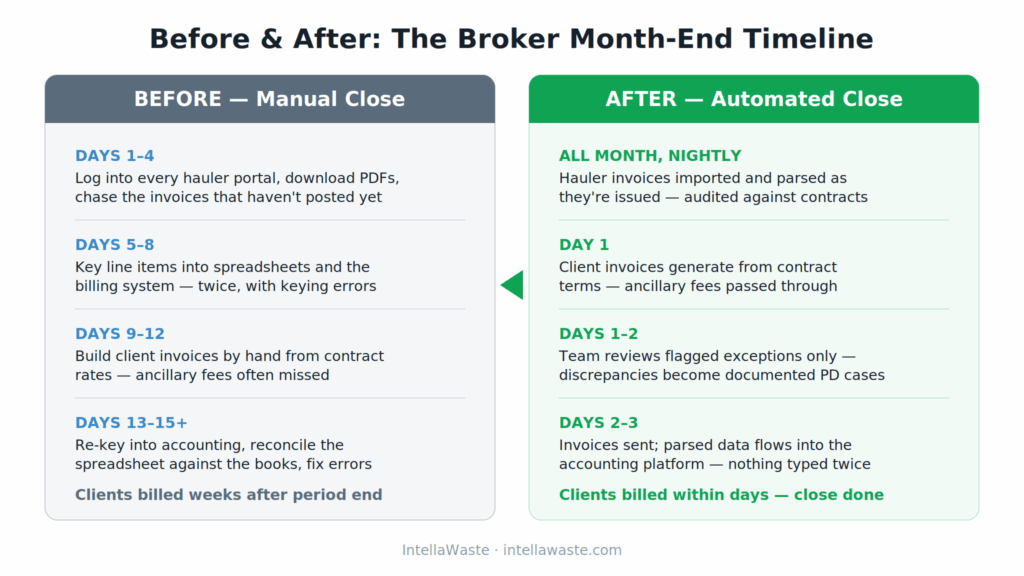
Here’s the typical calendar at a brokerage managing a few hundred client locations across dozens of haulers:
Days 1–4: Collection. The team makes the rounds — hauler portals, shared inboxes, the mail pile. Every portal has its own login and its own publishing schedule, and a handful of invoices simply haven’t been issued yet. Nothing downstream can start until they arrive.
Days 5–8: Data entry. Line items get keyed from PDFs into spreadsheets or the billing system — haul charges, fuel surcharges, overage fees, tonnage. Manual keying carries an error rate, and waste invoices are dense with near-identical lines, so a second person often re-checks the first person’s work.
Days 9–12: Client invoicing. Now the revenue side. Each client invoice has to reflect that client’s contract — their rates, their markup structure, and every legitimate ancillary charge from the hauler side that should pass through. This is where margin quietly leaks: an extra pickup or container delivery fee that never makes it from the hauler invoice onto the client invoice is money the brokerage earned and never billed.
Days 13–15 and beyond: Accounting and reconciliation. The same numbers get entered again — this time into QuickBooks or whatever platform finance runs — and then someone reconciles the spreadsheet against the books, chases the differences, and issues corrections. Clients are finally billed two weeks or more after the period ended, and receivables stretch accordingly.
Notice what the timeline is made of: almost none of it is judgment. It’s collection, transcription, and cross-referencing — exactly the work software does better than people. That’s not a criticism of the teams running it; as we covered in why brokers outgrow spreadsheets, manual operations are as organized as manual tools allow. The fix isn’t effort. It’s a different workflow.
Stage 1: Nightly Invoice Collection and Parsing
The automated close starts with a simple inversion: instead of collecting a month of invoices after the period ends, the platform imports hauler invoices continuously as they’re issued. On IntellaWaste, invoice uploads and parsing run automatically once an account is set up — clients on the platform import more than 10,000 waste invoices a day, and the system scales its processing capacity as volume grows. Even paper invoices fit the workflow: a batch can be scanned into a single PDF, uploaded, and automatically filtered, sorted, parsed, and assigned to the correct customer location using unique location and customer identification codes.
Parsing is the step that changes everything downstream. Each imported invoice is read line by line — base charges, surcharges, fees, quantities — and converted into structured data, with the original PDF retained for reference. There’s no keying, which means no keying errors, and the data exists as data from the moment it arrives. Because invoices flow in all month, the “collection” phase of the close simply stops existing as a calendar event.
There’s a bonus baked into this stage: since every invoice is now structured data sitting next to its hauler contract, it can be audited against that contract on arrival. Rate mismatches, surcharge math errors, and unauthorized fees get flagged the day the invoice lands — while the charge is still disputable — and become documented price discrepancy (PD) cases rather than overpayments. The audit isn’t a separate project anymore; it’s a side effect of how the data comes in.
Stage 2: Client Invoices That Generate Themselves
With hauler data structured and verified, the revenue side stops being a manual build. Automatic billing — available on IntellaWaste for consulting and brokerage customers — generates client invoices from the contract terms already stored in the platform: each client’s rates, markup structure, and billing rules applied consistently, every cycle.
The detail brokers care about most is ancillary fee pass-through. Because every line item on every hauler invoice was parsed in Stage 1, legitimate one-off charges — extra pickups, container deliveries, overage and yardage fees — are detected and carried onto the corresponding client invoice instead of depending on a tired analyst to spot them at 6 p.m. on day eleven. Underbilling from missed pass-throughs is one of the quietest forms of margin leakage in brokerage operations, and it disappears when the pass-through is systematic rather than manual.
The practical result: client invoices are ready when the period ends, not two weeks after. The team’s job shifts from building invoices to reviewing exceptions — the handful of flagged items that genuinely need a human decision.
Stage 3: Straight Into Accounting — Nothing Typed Twice
The final stage closes the loop with finance. Parsed hauler invoice data flows into the accounting platform through real-time invoice imports — IntellaWaste supports daily batch uploads into the accounting platform of your choosing, and integrates with the major systems brokers already run, including QuickBooks and NetSuite.
That single connection eliminates the entire re-keying step and, with it, the reconciliation that re-keying makes necessary. There’s one version of every number, traceable from the hauler’s original document through the client invoice to the general ledger. Month-end reconciliation stops being arbitration between a spreadsheet and the books, because there is no separate spreadsheet — the audit trail is built in.
The Automated Close: A Days-Long Timeline
Put the three stages together and the calendar transforms:
All month, nightly: hauler invoices import, parse, and audit themselves as they’re issued. Discrepancies become PD cases while they’re still disputable.
Day 1: client invoices generate automatically from contract terms, ancillary fees included.
Days 1–2: the team reviews flagged exceptions — the only invoices that need human attention.
Days 2–3: client invoices go out, and the same structured data lands in accounting. The close is done.
The compression isn’t a rounding trick; it’s the removal of waiting. In the manual close, most of the two weeks is spent waiting for collection to finish, then waiting for keying to finish, then waiting for checking to finish — each phase blocked by the one before it. Automation doesn’t make people work faster. It removes the phases.
What the Reclaimed Weeks Are Worth
The first payoff is cash flow: client invoices that go out on day two instead of day fifteen pull receivables forward by nearly two weeks, every month, across the whole book. The second is accuracy — no keying errors, no missed pass-throughs, and 100% of hauler invoices audited instead of the sample a busy team can manage, which matters when billing errors typically run 3–5% of waste spend. The third is capacity: staff who spent their first two weeks on collection and data entry get those weeks back for the work that actually grows a brokerage — winning accounts and advising clients. One long-time platform user, Global Trash Solutions, reports a 95% reduction in the labor costs tied to invoice handling after moving its collection and processing onto IntellaWaste.
The economics are deliberately simple: IntellaWaste runs $5 per location per month with unlimited invoices and no minimum location count, and the platform has processed more than 60 million invoices across roughly 15,000 customer locations since 2017.
Frequently Asked Questions
How does automated invoice collection handle haulers that don’t use portals?
Invoices arriving by email are imported from inboxes, and paper invoices can be scanned in batches into a single PDF — the platform automatically filters, sorts, parses, and assigns each one to the correct customer location.
Can automated client billing handle different markup structures per client?
Yes. Client invoices generate from each client’s own contract terms stored in the platform — rates, markup rules, and pass-through treatment are applied per account, so a 300-account book with 300 different arrangements bills correctly without manual assembly.
Does waste broker invoicing automation work with QuickBooks?
Yes. Parsed hauler invoice data can be batch-uploaded daily into the accounting platform of your choosing, and IntellaWaste integrates with major accounting systems including QuickBooks and NetSuite — so no number is ever typed twice.
How long does it take to get set up?
Setup centers on loading your locations and hauler contracts into the platform; once an account is configured, invoice collection and parsing run with little to no employee interaction. A free demo includes 20 locations and 20 hauler contract setups so you can see the workflow on your own accounts.
See Your Own Close Run in Days
The fastest way to understand the automated close is to watch your own messiest month run through it — your haulers, your contracts, your client book. Book a free IntellaWaste demo and see the timeline compress in real time. IntellaWaste provides waste management software solutions for businesses across the United States.