

For many organizations, next year’s waste budget begins with a familiar shortcut: take last year’s spending and add 3%. It is fast, easy to explain, and often wrong.
The problem is not the percentage itself. Three percent is not a standard waste-industry forecasting rule, and another percentage would not necessarily produce a better result. The real problem is using last year’s total before confirming that the total represents valid rates, necessary service, active locations, and enforceable contract terms.
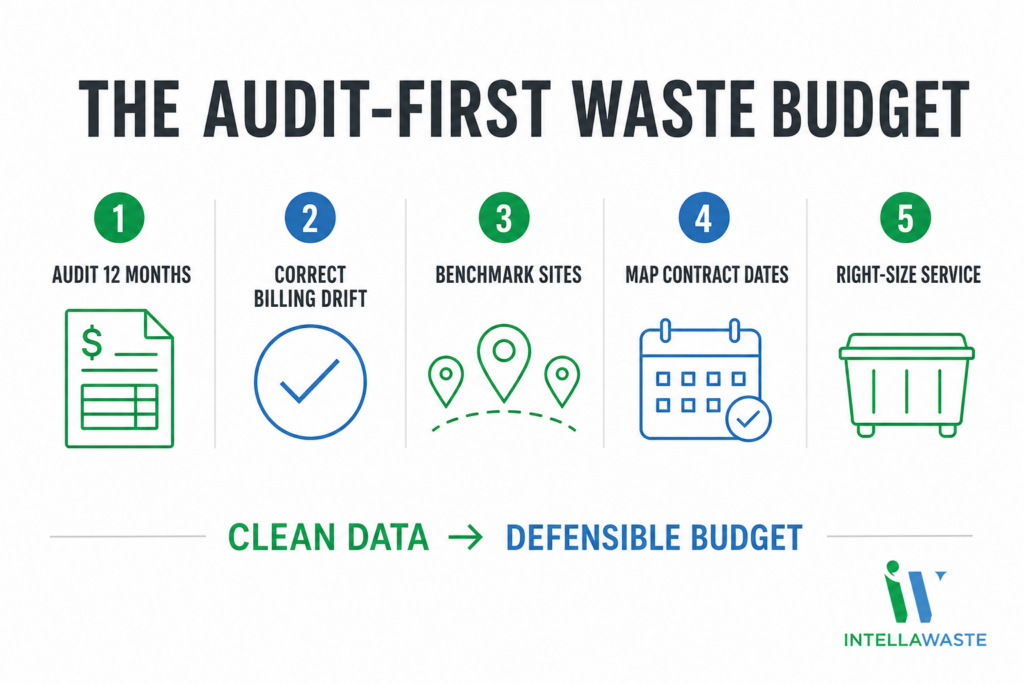
Effective waste management budget planning starts one step earlier. Before forecasting future costs, the organization needs to establish a clean operating baseline. That means auditing the trailing 12 months of invoices, correcting billing drift, comparing similar locations, mapping contract events to the fiscal year, and verifying that service levels still match what each site needs.
Once that information is structured and visible, budgeting becomes a controlled financial exercise instead of an annual guess.
Why “Last Year Plus 3%” Produces an Unreliable Waste Budget
Last year’s waste spending is not automatically a reliable baseline. It is simply the amount that was processed and paid during the year.
That total may include:
- Rates that changed without matching the contract
- Recurring ancillary charges that were never investigated
- Services billed after a location closed or changed ownership
- Temporary services that quietly became permanent
- Containers or pickup frequencies that no longer match demand
- Credits recorded in a different period from the original charge
- One-time events that should not be carried into the next year
Applying a percentage increase to that total does more than preserve these issues. It turns them into the organization’s new approved baseline.
A defensible budget needs to separate legitimate recurring costs from billing exceptions, operational changes, one-time charges, and future contract events.
The Audit-First Waste Budgeting Sequence
Step 1: Assemble the Trailing 12 Months of Waste Data
Begin with a complete trailing-12-month view rather than a single invoice or recent quarter. A full year helps capture seasonal demand, temporary services, annual rate changes, holiday schedules, location openings and closings, and irregular charges.
For each location, collect:
- Hauler invoices and credit memos
- Current contracts, amendments, and rate schedules
- Container type, size, quantity, and pickup frequency
- Extra pickups, overages, contamination charges, and other fees
- Location status, including openings, closings, relocations, and remodels
- Available weight, volume, diversion, or service-performance data
The information should then be standardized. Hauler names, service descriptions, container sizes, charge categories, dates, and location identifiers need to follow consistent formats before portfolio-wide comparisons will be meaningful.
The U.S. Environmental Protection Agency recommends tracking waste activity to establish a baseline before attempting to manage costs or performance. That same principle applies to budgeting: reliable decisions require a reliable starting point.
Step 2: Audit Invoices Against Contract Terms
Next, compare the invoice data with the controlling contract for each account. The objective is to determine which charges belong in the baseline and which require investigation.
Review items such as:
- Base service rates
- Permitted price increases and their effective dates
- Fuel or environmental charge calculations
- Administrative and regulatory fees
- Container rental charges
- Extra-service and contamination charges
- Taxes and governmental pass-through costs
- Billing after a cancellation, suspension, or location closure
Not every unusual charge is an error. Some are contractually permitted or connected to a documented service event. The audit should classify each exception as valid, pending review, disputed, credited, or corrected.
Do not reduce the budget for a suspected overcharge until the correction has been confirmed. Pending recoveries can be tracked separately, but the approved budget should distinguish documented savings from unresolved opportunities.
Organizations managing numerous accounts can use waste invoice auditing and contract-tracking software to compare invoice line items with stored rates and terms without rebuilding the analysis manually each year.
Step 3: Benchmark Comparable Locations
After the billing data has been cleaned, compare sites to identify outliers. This is particularly valuable for multi-location operators, brokers, and consultants because individual invoices rarely show whether a location is performing differently from the rest of the portfolio.
Raw monthly cost alone is not a fair benchmark. A distribution center should not be compared directly with a small office, and a six-day pickup schedule should not be compared with weekly service without accounting for the difference.
Group similar locations by relevant characteristics, such as:
- Facility or business type
- Geographic market
- Container type and size
- Scheduled pickup frequency
- Operating hours or transaction volume
- Waste stream and recycling program
Useful metrics may include monthly cost per location, cost per scheduled pickup, cost per cubic yard of scheduled capacity, cost by service type, or cost per operational unit. Weight-based comparisons can also be valuable when dependable tonnage data is available.
A site that costs more is not automatically inefficient. Its volume, local market, access restrictions, compactor requirements, or service needs may justify the difference. Benchmarking identifies where to ask questions; it does not replace the operational review.
For more on building a comparable portfolio view, see How to Track Waste Spending Across Locations.
Step 4: Map Every Contract Event to the Fiscal Year
Waste contracts and company budgets frequently operate on different calendars. A contract may renew in April, permit an increase in July, or require written notice several months before expiration.
Your contract calendar should include:
- Contract start and expiration dates
- Automatic-renewal terms
- Cancellation and non-renewal notice deadlines
- Permitted increase dates and calculation methods
- Planned bid or negotiation lead time
- Temporary-service end dates
Map these events against the fiscal year and budget only for the months affected.
For example, assume a service costs $4,000 per month and a verified 5% increase takes effect April 1. For a calendar-year budget, the increase affects nine months:
$4,000 × 5% × 9 months = $1,800
Applying 5% to the entire prior-year total would budget $2,400 for the increase—$600 more than the documented timing requires.
The contract calendar also protects negotiation leverage. A competitive bid cannot help if the required non-renewal notice date has already passed. Accounts approaching a viable bid window can be moved into a structured waste management RFP process before the deadline becomes an emergency.
Step 5: Right-Size Service Before Finalizing the Forecast
Invoice accuracy answers whether the company is being billed correctly. Service right-sizing answers whether the company is buying the right service in the first place.
Review the current container quantity, size, pickup frequency, recurring extra pickups, overflow history, contamination events, missed-service records, and seasonal patterns. Confirm the findings with facilities teams or site managers who understand what happens between pickups.
Possible adjustments may include:
- Reducing frequency where containers are consistently underused
- Increasing or restructuring service where overflows create recurring fees
- Removing containers that are no longer needed
- Scheduling temporary capacity only during seasonal peaks
- Separating recyclable material where operationally and economically practical
- Evaluating compactors or other equipment when reliable volume data supports the decision
Right-sizing should not mean cutting service simply to reach a budget target. An aggressive reduction that causes overflows, emergency pickups, safety concerns, or operational disruption can cost more than the original schedule. Use actual site conditions and service history to support the decision.
A Better Formula for Waste Management Budget Planning
Once the audit and operational review are complete, build the forecast using documented components:
Clean recurring baseline
– Confirmed billing corrections and discontinued services
± Approved service-level changes
+ Contractually supported increases
+ Planned openings, closures, remodels, and seasonal changes
+ A documented contingency for genuinely uncertain costs
= Proposed waste budget
This structure gives finance teams a traceable explanation for every material change. It also prevents one-time fees, unresolved disputes, and closed-location expenses from silently becoming permanent budget assumptions.
The Five Data Views That Make Budgeting Faster
An audit-first process becomes much more efficient when the data is already structured. The most useful budgeting views are:
- Monthly spend trend: Total portfolio spending by month, with credits and unusual charges visible.
- Location comparison: Comparable sites ranked by cost, service level, or another normalized metric.
- Rate and fee exceptions: Charges that do not match stored contract terms or normal billing patterns.
- Contract calendar: Expirations, notice deadlines, permitted increases, and planned bid dates mapped to the fiscal year.
- Service-level view: Container sizes, quantities, frequencies, extra pickups, and location-specific changes.
When these views are current, the annual budget review may be completed in a focused half-day working session. The first year can take longer if invoices, contracts, and service records are scattered or inconsistent. The time savings come from maintaining structured data throughout the year—not from skipping the audit.
Assign Owners Before Budget Season Begins
Waste information typically crosses several departments. Accounts payable sees invoices. Procurement owns contracts. Facilities understands service problems. Local managers know whether containers are full. Finance owns the final budget.
Assign clear responsibility for each part of the process:
- Finance: Forecast rules, approval, and variance reporting
- Accounts payable: Invoice completeness, credits, and payment records
- Procurement or legal: Contract terms, notice windows, and RFP timing
- Facilities or operations: Service validation and right-sizing
- Site managers: Local exceptions, seasonal changes, and operational confirmation
A central owner should maintain the portfolio view while involving local teams only when an exception requires operational confirmation.
Turn the Annual Budget Into a Monthly Management Tool
The budget should not disappear after approval. Compare actual spending with the clean forecast every month and explain material variances by location, hauler, fee category, or contract event.
This monthly review makes it easier to identify:
- An increase that began earlier than expected
- A credit that has not been received
- A temporary service that was not removed
- An opening or closure missing from the forecast
- A site whose service demand has changed
That is where waste management budget planning becomes more than a once-a-year finance exercise. The budget becomes a working control system for costs, contracts, and service decisions.
Build the Budget From Evidence, Not Inertia
Last year’s total can still be useful—but only after it has been audited, corrected, and connected to current operating plans.
The goal is not to force next year’s number lower. The goal is to make it accurate, explainable, and actionable. A well-built waste budget shows what the organization is paying for, when costs are expected to change, which sites require attention, and where contract or service decisions can improve the outcome.
Intellawaste helps brokers, consultants, and multi-site operators centralize invoice data, monitor contracts and service levels, audit charges, benchmark locations, and report across the portfolio.
Ready to replace “last year plus 3%” with a budget built from real data? Schedule an Intellawaste demo and see how your invoices, contracts, service levels, and budget decisions can work from one connected record.
Frequently Asked Questions
How many months of waste invoices should be reviewed for budgeting?
Review at least the trailing 12 months so the analysis captures seasonal activity, irregular fees, annual increases, temporary services, and location changes. Longer history can help when operations fluctuate significantly from year to year.
Should suspected billing errors be removed from the budget immediately?
No. Track suspected errors separately until the hauler confirms a correction or issues a credit. The approved budget should separate verified savings from unresolved recoveries.
What is the best way to compare waste costs across locations?
Compare similar sites and normalize for service level, facility type, market, operating activity, and available volume or weight data. Raw monthly cost alone can produce misleading comparisons.
Why should contract dates be included in the waste budget?
Contract expiration dates, permitted increases, and notice deadlines determine when rates may change and when an account can be renegotiated or competitively bid. Mapping these dates prevents full-year assumptions from being applied to partial-year changes.