
Every growing waste brokerage eventually runs into the same uncomfortable question: when you add 50 accounts, what else must you add?
In a manually run brokerage, the answer is usually people. More employees collect hauler invoices, enter data, check billing, track contract dates, build client reports, and chase exceptions. Revenue rises, but the work rises with it. The business gets bigger without becoming meaningfully more scalable.
That is the unit-economics problem hiding inside many successful brokerages. Each new account brings revenue, but it also brings another monthly bundle of repetitive tasks. If those tasks remain manual, labor becomes a toll charged against every stage of growth.
Learning how to scale a waste brokerage is not mainly about asking employees to move faster. It is about separating work that requires judgment from work that should run through a system. When collection, auditing, billing, alerts, and reporting become repeatable workflows, the team can spend more time winning clients and advising them.
The Growth Trap: When Accounts and Headcount Move Together
A brokerage can operate comfortably with spreadsheets, shared inboxes, and a few reliable employees when the account base is small. Everyone knows where the files live. A strong operations person can remember which hauler portal is late, which client needs a custom report, and which contract is approaching renewal.
Growth changes the math. Every account may bring several locations, different haulers, unique contract terms, varying service levels, and its own client-billing rules. The volume does not simply increase. The number of handoffs and exceptions multiplies.
The first response is often to hire. That can relieve immediate pressure, but it does not repair the operating model. The next block of accounts creates the same need again. Training takes longer, quality varies by employee, and critical knowledge becomes concentrated in the people who built the spreadsheets and workarounds.
That is why the right scaling metric is not only revenue per account. Owners should also watch how much operational labor each account consumes. If processing cost rises at nearly the same rate as revenue, growth can look impressive while margins remain stubbornly flat.
Operational Leverage Starts With the Work Behind the Work
Brokers create value through relationships, negotiation, cost control, market knowledge, and practical guidance. Yet experienced people often spend much of the month gathering the information they need before they can deliver that value.
The scalable approach moves routine data movement and verification into a platform. IntellaWaste is built around the workflows waste brokers and consultants actually manage, including automatic invoice uploads and parsing, hauler contract tracking, invoice auditing, customer contract monitoring, automatic billing, and financial reporting.
This does not remove people from the business. It changes where their attention goes. Software handles repeatable volume; people handle decisions, relationships, and exceptions.
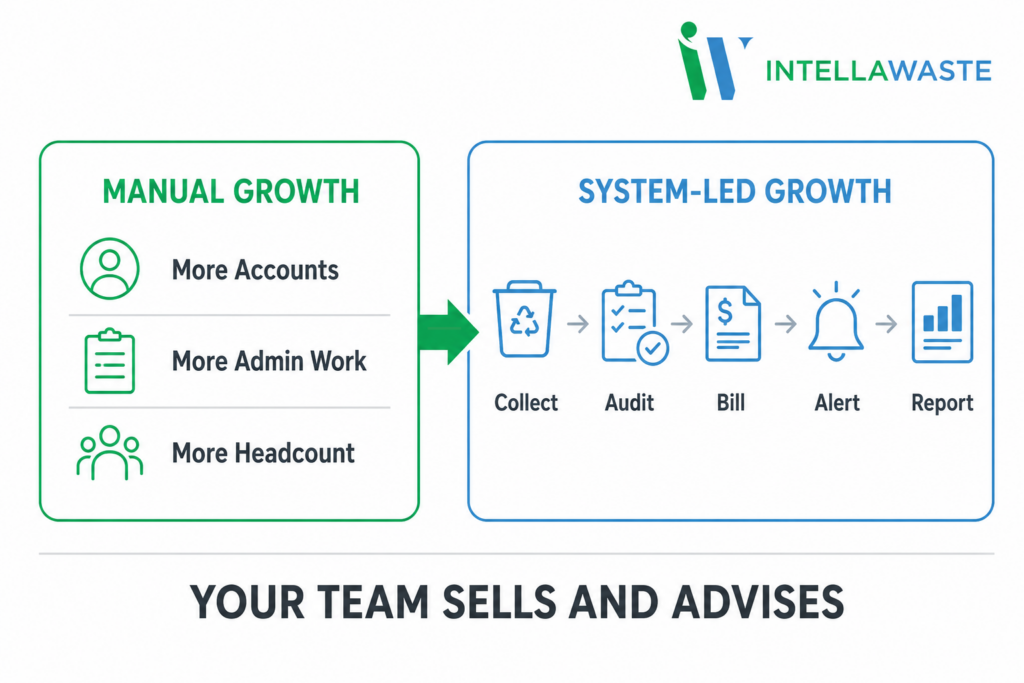
System-led growth removes repetitive administrative work from each new account while preserving the work that benefits from human judgment.
Five Workflows to Systematize Before the Next Growth Push
1. Invoice Collection and Parsing
A broker cannot audit or bill from an invoice it does not have. That makes invoice collection the first constraint to address. In a manual workflow, employees log into multiple hauler portals, monitor shared inboxes, download PDFs, rename files, and enter line-item data. Missing invoices become delayed client invoices.
Automated collection and parsing turns incoming hauler documents into structured data without requiring an employee to touch each one. This shortens the distance between a hauler posting an invoice and the brokerage being ready to review and bill it. For a closer look at that workflow, see The Hidden Cost of Manual Waste Invoice Processing.
2. Invoice Auditing
Manual audits create a bad choice: review every line and slow the month-end close, or spot-check invoices and accept that discrepancies will survive. Neither supports profitable growth.
A system can compare invoice details with stored contract rates and service terms as invoices arrive. Exceptions such as unauthorized increases, questionable surcharges, duplicate charges, and fees that do not match the agreed service can be surfaced for review. Analysts investigate the flagged items instead of rereading every ordinary line. The practical checks are outlined in IntellaWaste’s waste invoice audit checklist.
3. Client Billing
Client billing is often where upstream inefficiency becomes visible. If hauler invoices arrive late or must be keyed manually, client invoices wait. If pass-through charges or contract-specific billing rules live in a spreadsheet, employees must remember and apply them account by account.
When client billing generates from established contract terms, the brokerage removes repetitive re-keying and creates a more consistent process. The result is not only fewer administrative steps. Billing can begin sooner, which can improve the timing of receivables. See how the full workflow changes in How Waste Broker Invoicing Automation Cuts Month-End Close From Weeks to Days.
4. Contract Alerts and Renewal Windows
Contract dates are not passive records. An expiration date can trigger a renegotiation, an RFP, a client-retention conversation, or a risk if an evergreen clause quietly renews. In a spreadsheet, the date only matters if someone remembers to look at it in time.
A centralized system can surface approaching expirations and notice windows before they close. That gives sales and account teams time to review service history, analyze spend, prepare an RFP, and approach the client with a recommendation. Contract monitoring becomes a revenue-supporting workflow rather than a calendar emergency.
5. Client and Profitability Reporting
Reporting should be the output of clean operational data, not a separate monthly construction project. When invoices, contracts, services, discrepancies, and billing live in different files, every report requires gathering, reconciling, and formatting information again.
With structured data in one platform, teams can give clients clearer visibility into spending, service levels, and exceptions. Brokerage leaders can also examine profitability by account before margin erosion becomes a quarter-end surprise. IntellaWaste’s accounting integration article explains why connected operational and financial data changes the quality and speed of reporting.
What the Team Does Instead: Sell and Advise
Automation is most valuable when it gives skilled employees better work—not merely less work. Once routine processing is handled by a system, the team can redirect time toward activities that strengthen the brokerage.
Salespeople can pursue and onboard new accounts without worrying that each win will overwhelm operations.
Account managers can review trends, prepare recommendations, and speak with clients before small issues become complaints.
Analysts can investigate genuine discrepancies, identify savings opportunities, and protect account margins.
Leaders can evaluate growth using current operational and financial information instead of waiting for manually assembled reports.
That shift improves the client experience, too. Clients do not hire a waste broker because they want someone to download PDFs. They want market expertise, cost control, accurate billing, vendor accountability, and guidance. Systems protect the team’s capacity to provide those things as the account base expands.
How to Know Whether Your Brokerage Is Ready to Scale
Before adding another block of accounts, ask a few direct questions:
How many employee hours does invoice collection consume each month?
What percentage of invoices is audited against contract terms?
How long after hauler invoices arrive are client invoices issued?
Can the team see every contract expiration and notice deadline in one place?
Can leaders view current account profitability without building a new spreadsheet?
If a key operations employee left tomorrow, would month-end still close on time?
The answers reveal whether growth is supported by a repeatable system or by individual heroics. Heroics can carry a business through a busy month. They cannot be the permanent infrastructure for a larger brokerage.
Choose the First Bottleneck, Then Build Outward
A brokerage does not need to redesign every process in one day. Start where manual work blocks revenue most clearly. For many firms, that is invoice collection because nothing downstream can happen until the source invoice arrives. For others, it is client billing, contract visibility, or reporting.
The important point is to avoid automating one step while leaving employees to bridge disconnected systems by hand. The strongest gains appear when information flows through the full cycle: collection feeds auditing; approved data feeds client billing and accounting; contract terms power alerts and validation; structured records power reporting.
This connected approach is what turns software from another tool into operating infrastructure. It allows volume to increase without requiring the same increase in repetitive labor.
Scale the Expertise, Not the Administrative Load
The goal is not a brokerage with no people. It is a brokerage where people spend their time on the work clients value most.
When new accounts no longer bring an equal increase in invoice chasing, data entry, billing checks, renewal tracking, and report building, the economics change. Revenue can grow faster than back-office cost. Analysts regain time to analyze. Account teams become more proactive. Sales can pursue growth with confidence that operations can absorb it.
That is the real answer to how to scale a waste brokerage: build a system that handles the volume, then let the team provide the judgment.
See What Headcount-Flat Growth Could Look Like
IntellaWaste helps waste brokers and consultants automate invoice uploads and parsing, invoice auditing, contract monitoring, client billing, accounting imports, and reporting in one platform. Book a free demo to see how your current workflow could operate with less manual handling and more room for sales and advisory work.