
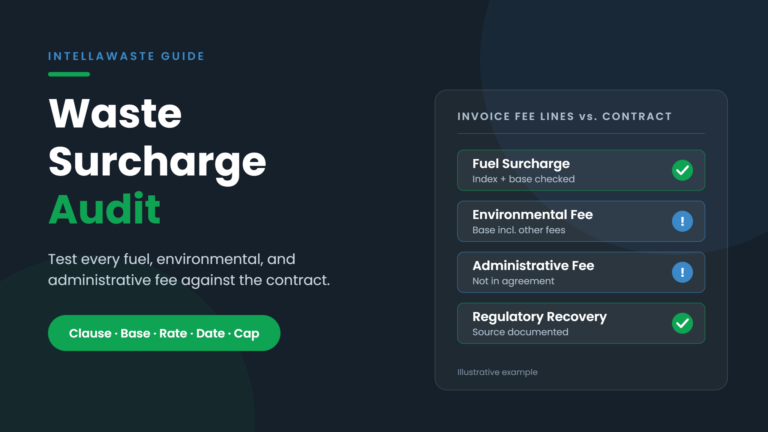
Surcharges are the part of a waste invoice most people approve without reading. The base collection rate gets attention because it’s in the contract and everyone remembers the number. The fuel, environmental, regulatory, and administrative lines underneath it get waved through because they look official and change too often to track by memory.
That habit runs in both directions. Some teams pay every fee without question. Others treat every fee as a scam and lose credibility with the hauler the first time they dispute a charge the contract clearly allows. A proper waste surcharge audit avoids both mistakes. It doesn’t ask whether you like the fee. It asks whether the contract permits it, whether the math is right, and whether the evidence supports the amount.
This guide walks through that test in seven steps, fee type by fee type.
What a Waste Surcharge Audit Actually Tests
An invoice is a record of what the hauler billed. The service agreement is a record of what the hauler is allowed to bill. A waste surcharge audit is the comparison between the two, done one fee at a time.
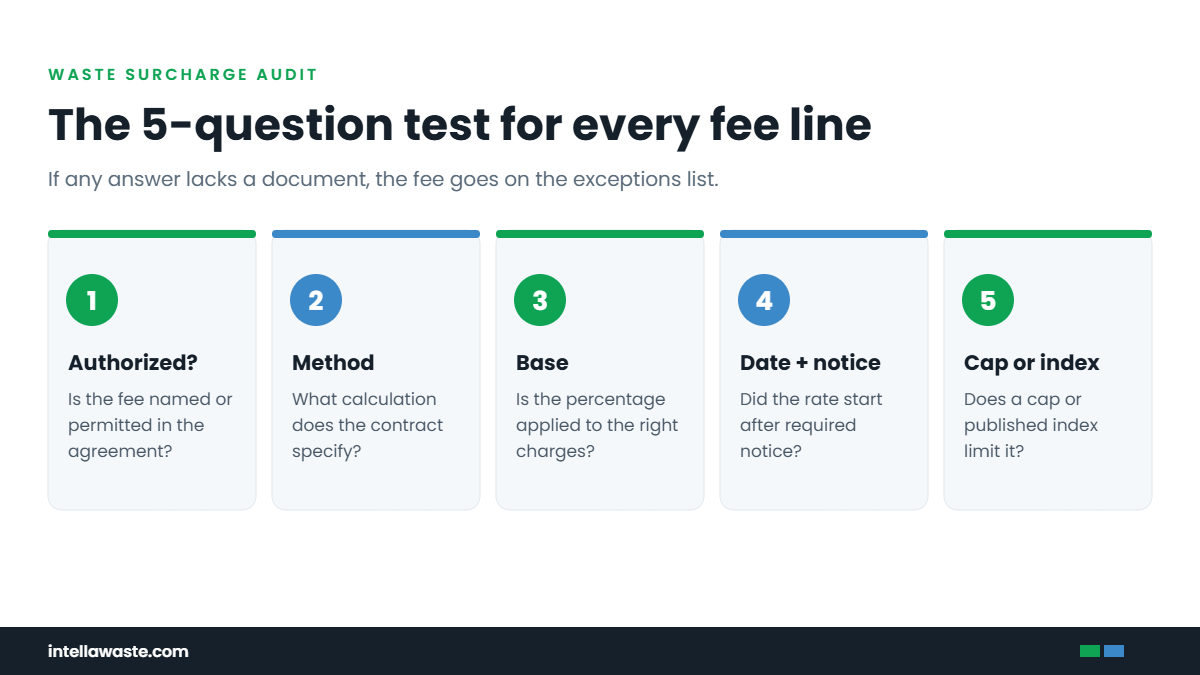
For every surcharge line, you’re trying to answer five questions. Is this fee named or permitted in the agreement? What calculation method does the agreement specify? What base is it applied to? When did the current rate take effect, and was notice required? Is there a cap, floor, or index that limits it?
If you can answer all five with a document, the fee is supported. If you can’t answer one of them, you have something to investigate. That’s different from “the hauler is overbilling.” Plenty of unanswered questions end with the hauler producing a clause or an amendment nobody had on file. The audit’s job is to find out which.
Know Which Kind of Fee You’re Looking At
Not all surcharges work the same way, so they can’t all be tested the same way. Before checking any math, sort each fee line into one of four groups.
| Fee type | Common examples | What drives the amount | The key audit test |
|---|---|---|---|
| Index-linked | Fuel surcharge, fuel recovery fee | A published fuel index and a rate table in the contract | Does the percentage match the index for that billing period, in both directions? |
| Percentage recovery | Environmental fee, environmental recovery fee, sustainability fee | A fixed or hauler-set percentage of some base | Is the fee permitted, and is the percentage applied to the correct base? |
| Flat administrative | Invoice fee, paper statement fee, account fee, late fee | A flat amount per invoice, account, or event | Is it in the agreement, and is it billed once per the stated unit? |
| Government pass-through | Franchise fees, local taxes, disposal or landfill pass-throughs | A rate set by a municipality or disposal facility | Can the hauler point to the actual government rate or facility charge? |
This sorting step matters because the most common audit mistake is applying the wrong test. A fuel surcharge that rose last month might be perfectly correct if diesel prices rose. An environmental fee that rose last month has no index to blame, so the increase needs a contract basis or a notice letter.
The 7-Step Waste Surcharge Audit
Run these steps on one invoice per site per hauler first. Once you’ve built the reference data in steps 1 and 2, the rest goes quickly.
Step 1: Build a fee register from the contract
Before you open an invoice, open the agreement. List every surcharge, fee, and pass-through the contract names, along with its calculation method, base, rate or rate table, cap, notice requirement, and effective date. Include amendments and rate letters. Put it in one place, by site.
This register is your standard. Without it, every invoice review turns into a memory test, and memory loses to a 40-line invoice.
Pay attention to vague language here. Clauses like “hauler may pass through increased costs” or “fees as set from time to time” give the hauler more room than a clause with a defined percentage. That doesn’t make every fee legitimate, but it changes what you can dispute. Flag broad clauses for the next renegotiation rather than the next dispute.
Step 2: Confirm each fee on the invoice is authorized
Now match every fee line on the invoice to a line in your register. Anything that doesn’t match goes on an exceptions list.
Watch for renamed fees. A charge that was “fuel surcharge” last year and “fuel and environmental recovery fee” this year may now be calculated differently. Watch for new fees that appear mid-contract with no amendment behind them. And watch for fees that are permitted at one site but showing up at a site under a different agreement, which happens when a hauler applies a regional default to every account.
Step 3: Verify the calculation base
This is where correct-looking surcharges go wrong. A percentage is only as good as the number it’s multiplied against.
If the agreement says the fuel surcharge applies to base collection charges, it shouldn’t also be charged on extra pickups, container rental, or the environmental fee. When surcharges are calculated on each other, they stack, and the invoice can be off even though every individual percentage matches the contract.
Recalculate at least one surcharge per invoice from the base up. If the hauler’s number and yours don’t match, work out which base they used. That tells you whether you’re looking at a one-time keying error or a billing system setting that’s been wrong on every invoice since it was configured.
Step 4: Check the rate against the index or the contract
For index-linked fees, find the index the contract names, often a published diesel price such as the U.S. Energy Information Administration’s weekly on-highway diesel average, and look up the value for the billing period. Then find the matching row in the contract’s rate table. Does the invoiced percentage match?
Check this over several months, not just one. Fuel surcharges should move down when fuel prices fall. A percentage that only ever climbs, or that stays flat through a drop in the index, deserves a closer look.
For fixed-percentage fees, the test is simpler: does the percentage on the invoice match the percentage in the register? If it’s higher, step 5 decides whether the increase is valid.
Step 5: Match effective dates and notice requirements
Many agreements require written notice before a fee is added or increased, sometimes 30, 60, or 90 days in advance. Some limit increases to once per contract year or to the anniversary date.
When a fee changes, find the notice. Compare the date the notice was sent with the date the new rate first appeared on an invoice. An increase that showed up on the invoice before the notice period ran out was billed early, even if the increase itself is allowed. An increase with no notice at all is a stronger exception.
Step 6: Apply caps and limits
Look back at the register for anything that limits the fee. Common examples include a maximum percentage for the fuel surcharge, an annual cap on combined increases, a flat-fee ceiling, or a clause excluding certain fees entirely for the contract term.
Caps are easy to miss because they rarely appear on the invoice. The hauler’s billing system knows the current percentage. It doesn’t always know your negotiated ceiling. If you have a cap, the audit is the only place it gets enforced.
Step 7: Document the exception and follow up quickly
For every exception, keep the invoice line, the contract clause, your recalculation, and the dollar difference together. A dispute that includes the clause and the math gets resolved faster than one that says “this fee seems high.”
Timing matters too. Paying a discrepant invoice without disputing it can make credits harder to get later, and repeated payment at a new rate can start to look like acceptance of that rate. Raise exceptions on the current invoice cycle, not at year-end.
Then track each one to a resolution: credit issued, rate corrected going forward, clause produced by the hauler, or exception closed with a reason. That record is how you know whether a problem was fixed or just argued about once. Our guide to waste hauler overbilling and price discrepancies covers that case management process in detail.
Fee-by-Fee: What to Look For
Fuel surcharges
Fuel is the fee most often tied to an outside index, which makes it the most testable. The common problems are a percentage that doesn’t match the index table for the billing period, a surcharge that doesn’t come back down when fuel prices fall, and a surcharge applied to charges beyond the contract’s stated base. If your contract has no index and no rate table, the fee is effectively set at the hauler’s discretion. That’s a negotiation issue to raise at renewal, and our waste RFP playbook covers how to write tighter terms into the next bid.
Environmental and recovery fees
Environmental fees usually aren’t tied to any index, so changes need a contract basis or a notice. Check whether the fee is named in your agreement at all. Then check the base. An environmental percentage applied on top of the fuel surcharge produces a slightly larger number every month, and it’s easy to miss. Our earlier look at hidden costs in waste management contracts explains why these fees deserve documentation requests when the agreement is vague.
Administrative fees
Administrative fees are small, which is why they survive. An invoice fee, a paper statement fee, or an account maintenance fee might be a few dollars. The test is whether the agreement lists it, and whether it’s being billed once per the stated unit. A per-account fee billed per invoice, or a per-invoice fee billed per service line, multiplies quickly across a large portfolio. Late fees deserve a separate check against your actual payment date and the agreement’s terms.
Regulatory and government pass-throughs
Franchise fees, local taxes, and disposal pass-throughs are often legitimate, and they often change for reasons outside the hauler’s control. The audit question is whether the amount matches the actual government or facility rate. Ask for the source. A hauler passing through a real municipal fee can usually show it. A charge labeled “regulatory” that can’t be tied to an actual regulation or facility rate belongs on the exceptions list.
Why Percentage-Only Reviews Miss the Problem
The most common shortcut in surcharge review is checking that the percentage on the invoice matches the percentage in the contract. It’s better than nothing. It also misses most of what goes wrong.
A correct percentage applied to the wrong base gives you the wrong charge. A correct percentage that took effect two months early gives you two months of overbilling. A correct percentage that should have dropped with the fuel index gives you a correct-looking number that’s out of date. None of those show up if all you compare is the rate.
This is the same idea behind exception-based waste invoice auditing: review what changed and why, rather than whether the total looks familiar. For surcharges, “what changed” includes the base and the effective date, not just the percentage.
How Brokers and Multi-Site Teams Scale Surcharge Audits
The seven steps above work on one invoice. They don’t hold up across hundreds of sites, multiple haulers, and dozens of contracts by hand. Each hauler formats surcharges differently, each contract defines the base differently, and fuel percentages change on a schedule nobody is tracking per account.
For brokers and consultants, there’s a second problem. Surcharges that are legitimate on the hauler invoice need to be passed through correctly to client invoices. A broker who audits hauler fees but misses them on client billing is protecting the client and losing margin at the same time.
This is the part software does better than people. IntellaWaste’s waste management software parses every invoice line item and checks it against contract terms, including allowed price increases, percentage charges, and one-time services. When a fee doesn’t match the agreement, it becomes a tracked price discrepancy case instead of a line someone noticed once. Pricing is $5 per location per month with unlimited invoices, and the platform has processed more than 60 million invoices since 2017. Parsed invoices flow into accounting systems like QuickBooks and NetSuite without re-keying.
If you’d rather start manually, our waste invoice audit checklist covers the broader set of checks beyond surcharges.
The Bottom Line
A fee with an official-sounding name is not the same as a fee with permission. A waste surcharge audit settles the question with documents: the clause, the base, the rate, the date, and the cap. Some fees will pass every test, and that’s useful to know too. The ones that don’t are where the recoverable money is, and the evidence you gather is what gets it credited.
If your team approves surcharges because they look reasonable, start with one hauler and one quarter of invoices. Build the fee register, run the seven steps, and see what the exceptions list looks like. Then decide whether you want to do that every month by hand.
See what a contract-first surcharge audit looks like on your own invoices. Book an IntellaWaste demo and we’ll walk through it with your hauler mix.
IntellaWaste provides waste management software solutions for businesses across the United States.