

An invoice can be accurate and still be expensive for the wrong reason. The rate matches the contract. Every pickup happened. Every fee is permitted. But the container is half empty at every collection, and nobody has asked whether the site still needs five pickups a week.
That’s the gap waste service right-sizing closes. Invoice auditing asks whether you’re paying what you agreed to pay. Right-sizing asks whether you should be buying that service at all. Both are cost controls, and multi-site portfolios need both.
Right-sizing also has a reputation problem. Done carelessly, it means cutting pickups to hit a savings target, then paying for overflow, emergency service, and frustrated site teams a month later. This guide covers how to do it responsibly: which inputs to gather, how to find the right candidates, what can go wrong, and how to prove the savings were real.
What Waste Service Right-Sizing Means
Waste service right-sizing is the process of matching each site’s container type, container size, quantity, and pickup frequency to the volume and conditions that site actually has today.
Sometimes that means less service. A store that changed its packaging, a building with lower occupancy, or a restaurant that started recycling cardboard may be paying for capacity it no longer uses. Sometimes it means more, or different, service. A site with recurring extra pickups is often cheaper on a larger container or one more scheduled pickup than on a pattern of on-call hauls.
The goal isn’t the smallest possible service. It’s the service that fits.
Why Service Levels Drift Out of Fit
Most service levels are set once, at contract start or site opening, and then renewed without review. Meanwhile the site changes.
Operating hours shift. A tenant leaves. A product line changes its packaging. A recycling program starts or stops. A remodel ends and construction debris disappears. Seasonal peaks get built into year-round service. None of that updates the hauler’s route sheet on its own.
Nobody owns the question, either. Facilities sees the dumpster. Finance sees the invoice. Procurement sees the contract. The person who could connect all three usually isn’t looking, which is why service fit tends to get reviewed only when someone complains.
The Inputs You Need Before Changing Anything
Right-sizing decisions are only as good as the data behind them. Before proposing a change at any site, gather the following.
| Input | What to look for | Where it usually lives |
|---|---|---|
| Container type, size, and quantity | What is actually on site versus what the contract and invoice say | Contract, invoice, site photos |
| Scheduled pickup frequency | Pickups per week by container and by material stream | Contract, hauler service records |
| Material stream | Trash, cardboard, single-stream recycling, organics, and how each is serviced | Invoice line items, site walk |
| Extra pickup and overage history | Recurring on-call hauls, overage charges, overflow fees, at least 12 months | Invoice history |
| Fill level at pickup | How full containers actually are when emptied | Site team, driver notes, photos, compactor data where available |
| Seasonality | Volume peaks by month or season, such as holidays or tourist season | 12 to 24 months of invoices, site team |
| Operating changes | New hours, occupancy, tenants, product mix, programs, closures | Operations, property management |
| Space and access | Enclosure size, truck access, loading dock schedules, local rules | Site walk, property manager |
| Site feedback | What staff see: overflow, odor, pests, blocked access, missed service | Site manager |
The first two rows describe what you’re buying. The rest describe what you need. Right-sizing is the comparison between them.
Two inputs deserve extra weight. Extra pickup history is the clearest sign that service is too small, because the site is already paying to fix it. And site feedback is the clearest check on any change that looks good on paper, because the people at the loading dock know things the invoice doesn’t.
How to Find the Right Candidates
Don’t start by reviewing every site. Start with the ones the data points to. In a portfolio, right-sizing candidates tend to show up as patterns.
Similar sites, very different service
Group locations that should generate similar waste: same business type, similar size, similar hours, same material streams. Then compare service levels and cost per site within each group. When two comparable stores are on very different container sizes or pickup schedules, one of them deserves a closer look. It isn’t automatically the bigger one. Sometimes the smaller service is the one generating overflow charges.
Recurring extra pickups
A site that orders extra hauls every month is telling you its scheduled service is too small. Total up the extra pickups and overage charges for the past year, then compare that against the cost of a larger container or one more scheduled pickup. The scheduled option is often cheaper and more reliable.
Persistent underuse
If site staff or driver notes consistently report containers half full or less at pickup, the site may be paying for capacity it doesn’t use. Confirm this over several weeks and across seasons before acting. One slow month proves nothing.
Service that predates a business change
Flag any site where the operation changed but the service didn’t: a remodel that ended, a tenant that left, a program that started, hours that were cut. These are often the easiest wins, because the reason for the original service level no longer exists.
Clean data makes all of this possible. If container sizes are recorded three different ways or sites are mislabeled, the comparisons won’t hold up. Our guide to waste data quality covers the cleanup that should come first.
Safeguards Against False Savings
The biggest risk in right-sizing isn’t missing a savings opportunity. It’s booking savings that don’t exist. A reduction in scheduled service that triggers more extra pickups hasn’t saved anything. It has moved the cost to a different invoice line.
Build these safeguards into every change.
Watch the whole invoice, not one line. Compare total cost per site before and after, including extra pickups, overage fees, overflow charges, and contamination fees. A drop in the scheduled service line paired with a rise in on-call charges is a warning sign.
Account for costs that never appear on the invoice. Employee time spent breaking down boxes to fit a smaller container, managing overflow, or calling the hauler is a real cost. So are pest problems, odor complaints, tenant complaints, and health inspection issues. Ask the site team before and after.
Respect peaks. A schedule that works in a slow month can fail during the holidays or peak season. Consider seasonal service changes where the contract allows them rather than one year-round level that’s wrong for half the year.
Check the contract before you call the hauler. Some agreements set minimum service levels, charge fees for service changes, or reprice the account when service drops. A smaller container can carry a higher per-yard rate. Know the terms first. If the agreement makes sensible changes expensive, that’s a point for the next bid or renewal.
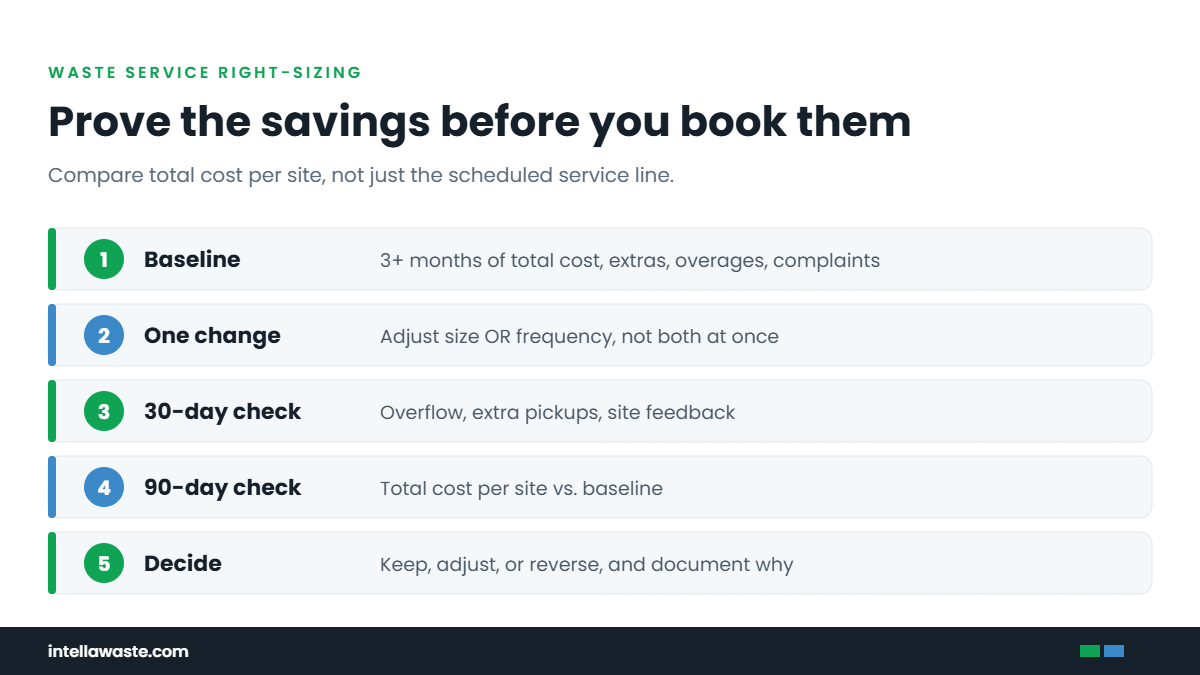
Change one thing at a time. If you reduce container size and pickup frequency in the same week, you won’t know which change caused a problem. Make one adjustment, measure it, then decide on the next.
A Before-and-After Measurement Plan
Every right-sizing change should come with a way to prove whether it worked. Keep the plan simple and agree on it before the change happens.
Start with a baseline. Record the site’s total monthly waste cost, scheduled service, extra pickups, overage and overflow charges, and any site complaints for at least the prior three months. Use the same months from the prior year when seasonality matters.
Then set a review window. Thirty days catches obvious problems. Ninety days gives a real read on cost. For seasonal sites, check again when the next peak arrives.
At each review, compare total cost per site against the baseline, not just the scheduled service line. Compare extra pickups and overage charges. Ask the site manager whether anything got worse. Then make a call: keep the change, adjust it, or reverse it.
Reversing a change isn’t failure. It’s evidence. A documented reversal tells you that site’s current service fits, which is useful the next time someone proposes cutting it.
Finally, confirm the change shows up correctly on the invoice. A reduced service that the hauler keeps billing at the old level turns a right-sizing win into a billing problem. Our guide to waste service verification covers how to confirm the service on the record matches the service performed.
Right-Sizing Is an Ongoing Control, Not a Project
Many companies run right-sizing as a one-time cleanup, then let service drift again for five years. It works better as a regular review: a quarterly look at outliers and extra-pickup patterns, plus a check whenever a site changes how it operates.
That rhythm fits naturally alongside other recurring reviews. Our waste management budget planning guide includes right-sizing as a step before the forecast is finalized, and our overview of multi-site waste management software explains why portfolio-wide comparisons matter for spotting outliers in the first place.
How IntellaWaste Supports Right-Sizing Decisions
Right-sizing depends on seeing service levels and costs side by side across every site. That’s hard to do when container details live in contracts, extra pickups live in invoice PDFs, and site changes live in someone’s inbox.
IntellaWaste’s Service Level Tracking records the number of containers, container size, type of service, and pickup frequency for every customer account. Automatic invoice parsing assigns each line item to the correct location, so recurring extra pickups and overage charges show up as patterns instead of scattered line items. Brokers and consultants can compare similar accounts, find the outliers, and bring evidence to the conversation with the client and the hauler.
Pricing is $5 per location per month with unlimited invoices, and there’s no minimum number of locations.
The Bottom Line
Audit the bill for accuracy. Then audit the service for fit. Those are different controls, and the second one is often where the larger savings sit.
Responsible right-sizing starts with evidence, not intuition: what’s on site, how full it gets, how often extras are ordered, and what the site team sees. It protects against false savings by watching total cost, not one line. And it proves results with a baseline and a review date.
Start with the sites that already show the pattern: recurring extra pickups, comparable sites on very different service, or service that hasn’t changed since the business did. Book an IntellaWaste demo to see service levels and costs side by side across your own portfolio.
IntellaWaste provides waste management software solutions for businesses across the United States.