Ask ten multi-site companies who manages their waste and you will hear ten different answers. In one, a store manager signs the hauler agreement, approves the invoice, and calls the local office when a pickup is missed. In another, a corporate procurement team controls every contract, and the site manager finds out about a service change when the container disappears.
Both models break. The first loses leverage and visibility. The second loses the facts that only the site can see. Companies that run waste well across dozens or hundreds of locations tend to land in the same place: centralized waste management for the rules, records, and contracts, with local teams owning the conditions on the ground.
Agreeing with that in principle is easy. The hard part is deciding which decisions belong where and writing it down. This article gives you a governance matrix you can adapt, the approval thresholds and escalation rules that make it work, and the record-keeping habit that keeps corporate and the sites from working off different versions of the truth.
What Centralized Waste Management Actually Means
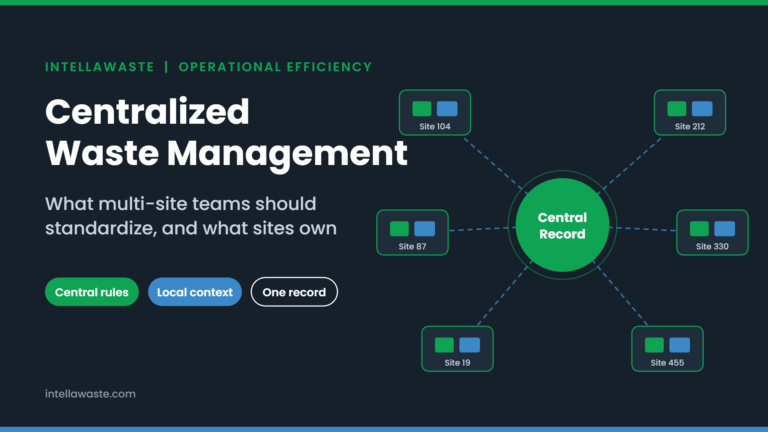
Centralized waste management does not mean corporate makes every call. It means one team owns the standards, the data, and the commercial relationships, and every location operates inside that structure.
The central team controls a short list: the site and account record, contract terms and renewal dates, the rules for approving charges and service changes, reporting definitions, and the escalation path when something goes wrong. Everything else comes down to who has the best information. Usually that is the site.
Here is a quick test. If a wrong decision at one site would repeat at fifty, it belongs to the center. If a right decision depends on what someone can see from the loading dock, the site needs a say.
Why Fully Local Waste Management Breaks at Scale
The local model is rarely a choice. It accumulates. A company opens locations one at a time, and each new site sets up waste the way the last site manager did, or the way the hauler suggested.
A few years later, the portfolio has as many waste programs as it has addresses. The same container on the same schedule costs different amounts at different sites because each agreement was negotiated alone, or never negotiated at all. Contracts sit in a filing cabinet at the location. Renewal windows close because nobody at corporate knew the agreement existed. A site manager approves a new fee because the hauler’s rep explained it over the phone.
Visibility goes next. Finance can see total waste spend. It cannot see why one store costs twice as much as a comparable store across town, whether that store is under contract, or whether the extra pickups it pays for every month were ever requested. Our guide to multi-site waste management software covers the visibility side of this problem. The governance side is simpler to state: when nobody owns the standard, every site invents its own.
Why Fully Centralized Waste Management Breaks Too
The opposite model fails more quietly. Corporate takes over contracts, approvals, and service decisions, then starts managing locations from a spreadsheet.
The spreadsheet says an 8-yard container picked up twice a week is plenty for a store that size. The loading dock says the enclosure overflows every Friday because deliveries land on Thursday. The spreadsheet says a pickup was missed. The site knows the truck could not get in because a delivery vehicle was parked across the gate. A central team that never asks those questions makes decisions that look efficient and produce overflow charges, extra hauls, and frustrated site staff.
Over-centralization also slows down the problems that need speed. A missed pickup at a restaurant on a Friday afternoon has a window measured in hours. Sending it through a corporate ticket queue does not improve the outcome.
The Centralized vs. Local Waste Management Governance Matrix
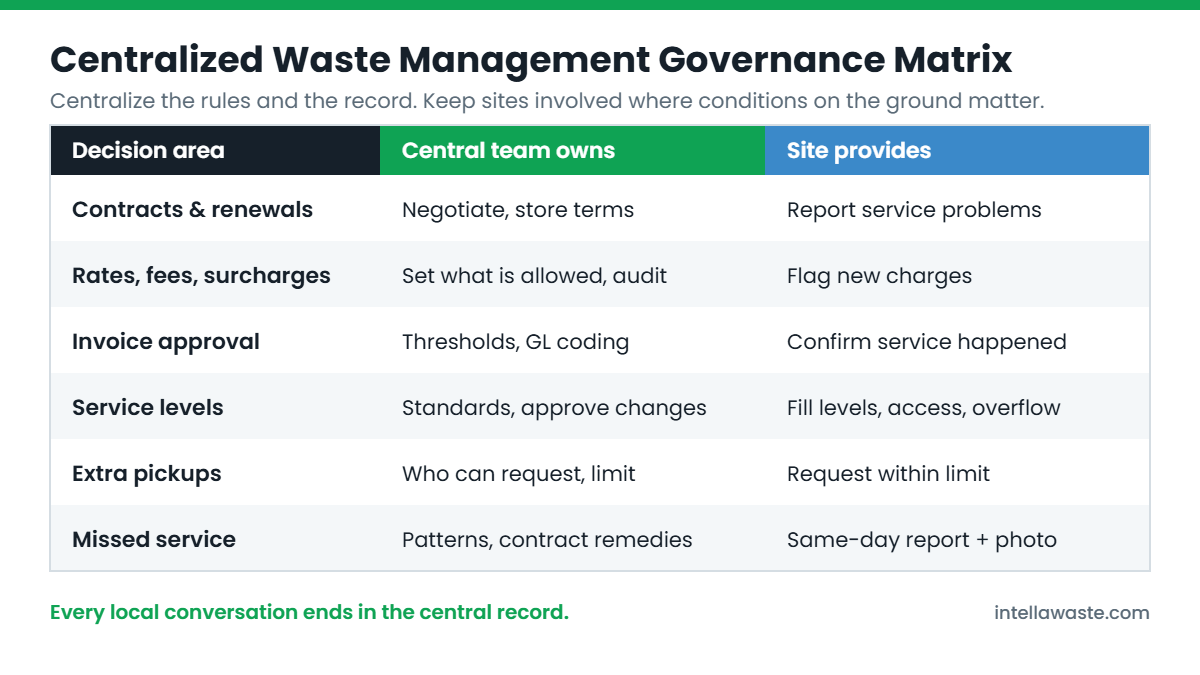
The matrix below is a starting point. Adjust it for your portfolio size, your industry, and whether a broker or consultant manages part of the program. The goal is simple: every recurring decision has one owner, a clear contributor, and a record that returns to one place.
| Decision area | Central team owns | Site provides | Regional lead or broker |
|---|---|---|---|
| Site and account record | Site IDs, hauler account mapping, open and closed status | Openings, closures, remodels, and hours changes, with effective dates | Confirms changes across assigned sites |
| Hauler contracts and renewals | Negotiation, stored terms, notice windows | Service problems that should shape the next renewal | Groups sites for bids and advises on local markets |
| Rates, fees, and surcharges | What is allowed, and the invoice audit against it | Any new charge a hauler mentions on site | Escalates disputed fees |
| Invoice approval | Approval thresholds and GL coding rules | Confirmation that service happened, when asked | Approves exceptions above the site limit |
| Service levels | Standards by site type and approval of permanent changes | Fill levels, overflow, access limits, seasonal swings | Reviews outliers against peer sites |
| Extra pickups and one-time service | Who can request, and the spending limit | Requests within the limit, with a reason | Reviews recurring patterns |
| Missed service and access issues | Patterns by hauler and contract remedies | Same-day report, with photos where possible | Escalates repeat failures |
| Recycling and contamination | Program rules and reporting definitions | Staff training and problem reports | Compares participation across sites |
| Reporting and KPIs | Metric definitions and data sources | Explanations for outliers | Reviews regional results |
Read the table by column, not by row. The central column is the list of things that must be the same everywhere for the portfolio to be comparable. The site column is the list of facts the central team cannot get any other way. The middle layer exists to keep the first two connected, and in many portfolios that role belongs to a broker or consultant rather than an internal regional manager.
Decision Rights Need Thresholds, Not Just Owners
An owner list tells people who decides. Thresholds tell them when to stop and ask. Without thresholds, “site provides input” drifts back into “site decides,” or corporate ends up approving every extra haul by email.
Three thresholds do most of the work.
The first is a spending limit for extra and one-time service. A site manager can order extra hauls up to a set amount or count per month without approval. Beyond that, the request goes to the regional lead or central team. When a site keeps hitting the limit, the answer is not more approvals. It is a service review, which our guide to waste service right-sizing walks through.
The second covers permanent service changes. Any change to container count, size, material stream, or pickup frequency goes through the central team, because it changes the baseline every future invoice is checked against. A site can request the change. It should not be able to make it alone.
The third is a variance rule for invoices. Bills that match contract terms and the service record can move through on a routine schedule. Anything that does not match, such as a new fee, a rate change, or a charge at a closed site, becomes an exception with a named owner. That is the logic behind exception-based invoice auditing, and it only works if the central team owns the comparison.
Be careful with dollar floors on that variance rule. A $15 discrepancy is not worth a dispute at one site. The same $15 at two hundred sites, every month, is a pattern that belongs in the central queue.
Every Local Conversation Should End in the Central Record
The most common failure in a hybrid model is not a bad decision. It is a good decision nobody wrote down.
A site manager calls the hauler about a damaged lid, and the hauler agrees to waive the replacement fee. A regional lead arranges a temporary container for a remodel. A store asks to drop Saturday service. Each conversation might go well. If the outcome lives in one person’s inbox, the next invoice gets audited against the old service profile, the waived fee gets paid, and the temporary container quietly becomes permanent.
The fix is one rule. Local teams can have the conversation. The result goes into the shared record: what changed, the effective date, who agreed to it, and the document that proves it. Our article on waste data quality explains why the effective date matters more than the date someone gets around to entering it.
Site status changes deserve the strictest version of this rule. When a location closes, sells, or pauses, the waste account has to end on purpose. The site closure offboarding workflow starts with a notice from operations to whoever owns the record. In a centralized model, that owner is never in doubt.
Escalation: Who Acts First and Who Acts Next
Escalation is where vague governance becomes expensive. When nobody knows who acts next, a missed pickup turns into three missed pickups, and a billing question turns into a paid invoice.
Routine service problems should start at the site, because the site sees them first. A missed pickup or blocked enclosure gets reported the same day, ideally with a photo, and the site makes the first call to the hauler. If the issue is not resolved inside a defined window, or if it is the second occurrence in a month, it moves to the regional lead or central team. That team holds the contract and the leverage that comes with it.
Billing disputes work the other way. They should start at the center, because they depend on contract language, invoice history, and evidence the site does not have. Speed matters here too. IntellaWaste’s hauler overbilling case management guidance explains why: paying a discrepant invoice can make a credit harder to recover, and some haulers treat payment as acceptance of the new price. A site that approves a disputed bill to keep the account current can undo the central team’s case.
How Waste Brokers and Consultants Fit the Model
For brokers and consultants, governance is part of the service. In many client relationships, the broker effectively is the central team. It holds the hauler contracts, audits the invoices, runs the bids, and handles disputes.
What the broker cannot do is see inside the client’s locations. It finds out about a closure, a remodel, or a service complaint only if someone at the client reports it. That makes the site column of the matrix a client responsibility, and it belongs in onboarding. Agree on who at the client reports status changes, who can request extra service, and what the spending limit is before the first invoice cycle.
A clear matrix also supports the broker’s commercial work. Contract terms, renewal dates, and service profiles held in one place make it easier to group compatible sites for a bid. Our waste RFP playbook covers how to build that bid from real service data instead of the incumbent hauler’s description.
Rolling Out a Hybrid Model Without Starting Over
You do not need a reorganization to fix waste governance. Most teams can move to a working hybrid model in one quarter.
Start with the record. Build a single list of every active site, hauler account, service, and contract, and assign each location a permanent internal ID. That list is what the central team owns, so it has to exist first.
Then publish the matrix. One page is enough. Send it to every site manager and regional lead with the three thresholds written out in dollars and counts, plus the one channel sites should use to report changes and problems. Pick a single channel. A shared inbox, a form, or a platform workflow all work. Five channels do not.
After one quarter, review what came through. Look for sites that never report anything, extra-pickup limits that get hit every month, and disputes that stalled because nobody knew whose move it was. Adjust the thresholds and the owners, not the principle.
Where IntellaWaste Fits
A hybrid model depends on one shared record that every team can trust. IntellaWaste is built around that record.
Invoices are uploaded and parsed automatically, then assigned to the correct location using unique location and customer identification codes. Each one stays available for viewing and tracking indefinitely, so a site-level question always traces back to the source document. Service level tracking records the number of containers, container size, type of service, and pickup frequency for every account, which gives the central team the baseline that permanent service changes should update.
Hauler contract tracking and invoice auditing checks each bill against its contract terms, including allowed price increases, percentage charges, and one-time services. Most hauler contracts run 12 to 60 months. When a location is billed beyond its contract terms, hauler overbilling case management (price discrepancies, or PDs) gives the central team a case to address right away. Hauler invoices also import into accounting software such as QuickBooks and NetSuite, without manual entry.
For brokers and consultants, IntellaWaste adds customer contract monitoring and automatic billing. You can see the full set of IntellaWaste waste management software tools on the products page.
IntellaWaste has been helping businesses save since 2017. The platform has processed 60 million invoices and supports 15,000 customer locations. Pricing is $5 per location per month with unlimited invoices, and there is no minimum number of locations.
Frequently Asked Questions
What is centralized waste management?
Centralized waste management is an operating model in which one team owns waste contracts, the site and account record, approval rules, reporting definitions, and escalation for every location. Sites still report service conditions and handle day-to-day issues inside those rules.
Is centralized or decentralized waste management better for multi-site companies?
Most multi-site companies do best with a hybrid. Centralize the decisions that need to be consistent across the portfolio, such as contracts, rates, approvals, and data. Keep sites involved in the decisions that depend on local conditions, such as access, overflow, seasonal volume, and missed service.
Who should approve waste invoices in a multi-site company?
The central team should set the approval rules and own the audit against contract terms. Invoices that match the contract and service record can be approved on a routine schedule. Exceptions should go to a named owner, with the site confirming whether service actually occurred.
How do waste brokers fit into a centralized model?
A broker or consultant often acts as the central team, holding contracts, auditing invoices, and running bids. The client still owns the site-level facts, so the two should agree during onboarding on who reports closures, service changes, and problems, and how extra service gets approved.
Give Every Decision an Owner
Centralized waste management works when the rules are central, the facts are local, and every conversation ends in the same record. Get that right, and site comparisons mean something, renewal dates stop slipping, and disputes reach the person who can resolve them.
If your waste decisions currently live at the site, the region, and corporate all at once, start with the record. Book an IntellaWaste demo to see how one shared record of sites, contracts, service levels, and invoices supports both the central team and the people at each location.
IntellaWaste provides waste management software solutions for businesses across the United States.